
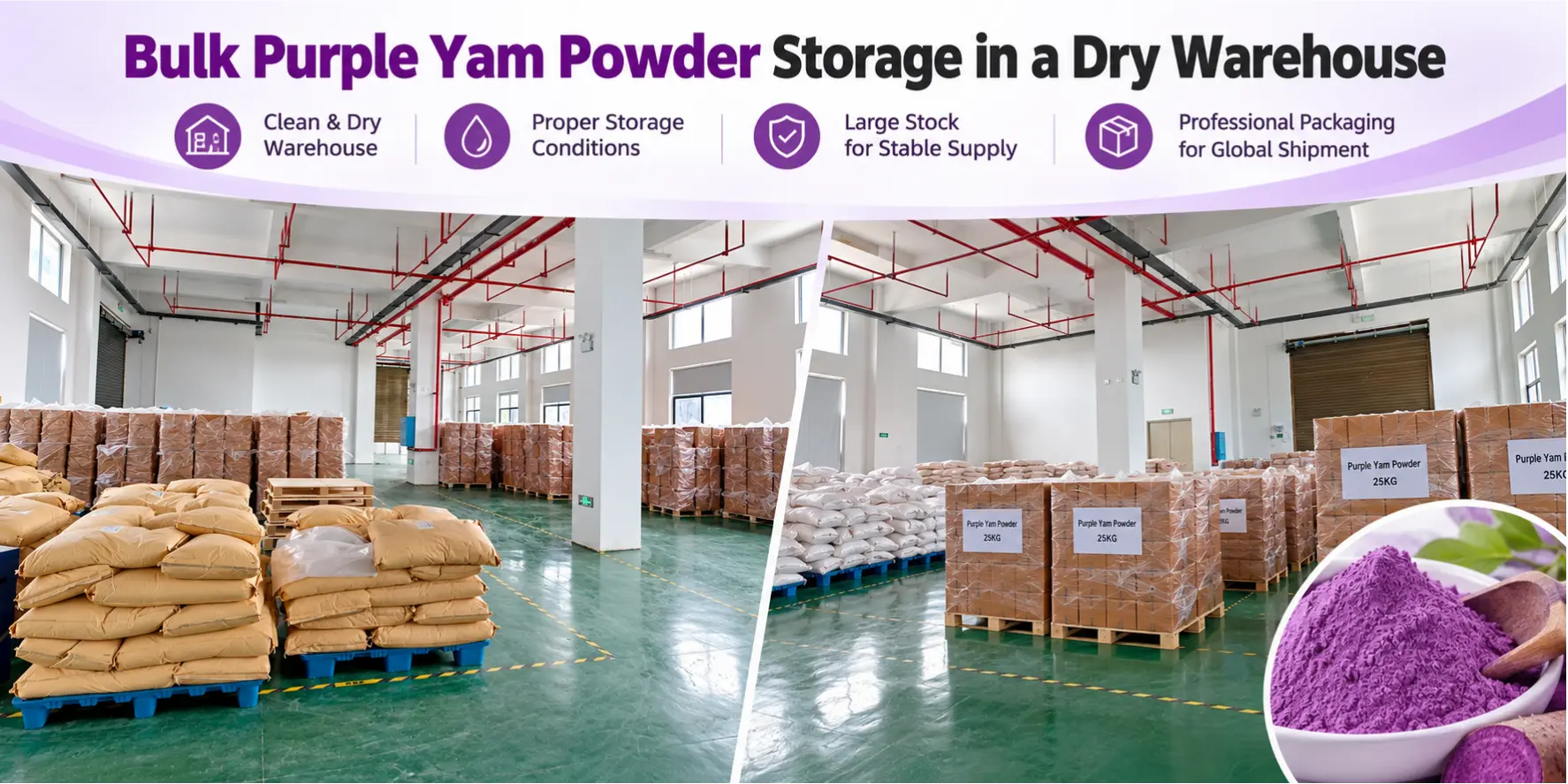
Purple yam powder shelf life is an important consideration for food manufacturers, ingredient distributors, and international buyers sourcing ube powder in bulk.
Whether you are developing ube lattes, bakery products, ice cream, or instant dessert mixes, understanding how long purple yam powder lasts can help you protect ingredient quality, manage inventory, and reduce unnecessary waste.
So, how long does purple yam powder last?
The answer depends on the product’s manufacturing process, moisture content, packaging, and storage conditions.
For example, the regular purple yam powder and freeze-dried ube powder supplied by Changsha Vigorous-tech Co., Ltd. both have a specified shelf life of 24 months when properly sealed, protected from moisture, and stored away from direct sunlight, according to their product documentation.
However, a 24-month shelf-life declaration does not mean that every purple yam powder on the market has the same stability.
Scientific research shows that factors such as water activity, temperature, oxygen exposure, and natural pigment stability can influence the quality of dried food ingredients during storage.
In this article, we combine published food science research with our actual product specifications to explain:
Our goal is to help commercial buyers make informed purchasing decisions based on scientific evidence and verifiable product documentation.
Purple yam powder, also known as ube powder, is produced from the edible tuber of Dioscorea alata.
It is used in a variety of food and beverage applications, including:
Purple yam powder is typically manufactured by dehydrating purple yam and reducing it to a powder.
Different drying technologies can influence its moisture content, particle characteristics, appearance, and storage performance.
The distinctive purple coloration of purple yam is associated with naturally occurring anthocyanin pigments.
Scientific studies have shown that anthocyanins can be sensitive to environmental conditions, including temperature, light, oxygen, and pH [1].
These characteristics are relevant when evaluating the long-term appearance and quality of purple yam powder.
*If you are new to this ingredient, explore our comprehensive guide to What Is Purple Yam Powder? to learn more about its botanical origin, characteristics, and food applications.
There is no universal shelf life for all purple yam powders.
The appropriate shelf life depends on the specific product, its packaging, manufacturing conditions, and supporting quality data.
Some commercially manufactured dried purple yam powders have a stated shelf life of approximately 12–24 months.
However, buyers should always follow the shelf life specified by their supplier for the relevant product and batch.
Our Purple Yam Powder Shelf Life Specifications
According to our available Certificates of Analysis (COAs), Changsha Vigorous-tech Co., Ltd. supplies two purple yam powder options with the following specifications:
| Parameter | Regular Purple Yam Powder | Freeze-Dried Ube Powder |
|---|---|---|
| Botanical Name | Dioscorea alata | Dioscorea alata |
| Plant Part | Root | Root |
| Appearance | Fine light purple powder | Fine purple powder |
| Moisture Specification | NMT 12.0% | NMT 8.0% |
| Particle Size | NLT 90% through 60 mesh | NLT 90% through 80 mesh |
| Standard Packaging | 25 kg/drum | 25 kg/drum |
| Declared Shelf Life | 2 years | 2 years |
| Storage Requirements | Sealed, protected from moisture and direct sunlight | Sealed, protected from moisture and direct sunlight |
NMT: Not More Than
NLT: Not Less Than
Both products have a declared shelf life of two years under the specified storage conditions.
The actual expiration date should be verified using the documentation associated with the purchased batch.
Does a Two-Year Shelf Life Mean the Powder Will Never Change?
No.
Shelf life represents the period during which a product is expected to remain within its defined quality and safety requirements under specified conditions.
It does not mean that every characteristic remains completely unchanged.
For example, natural pigment intensity, aroma, or powder flowability may gradually change during storage.
Whether those changes are acceptable depends on the product’s specifications and intended application.
A shelf-life declaration should ideally be supported by appropriate product-specific stability data.
Understanding the scientific factors affecting shelf life can help buyers evaluate products more effectively.
Three important areas are moisture availability, pigment stability, and processing technology.
3.1 Moisture Content and Water Activity
Moisture content is commonly used to evaluate dried food powders.
However, moisture content and water activity are not the same measurement.
Moisture content refers to the total amount of water present in a product.
Water activity (aw) describes the availability of water for microbial growth and certain chemical reactions.
According to the U.S. Food and Drug Administration (FDA), water activity is an important factor influencing microbial growth and food stability [2].
The FDA also explains that the relationship between moisture content and water activity depends on how water interacts with the components of a food.
This means that two powders with similar moisture contents may have different water activity values.
Why Is This Important for Purple Yam Powder?
Purple yam powder contains starch and other natural plant components.
The relationship between moisture content and water activity depends on the powder’s composition and processing characteristics.
Therefore, a moisture specification alone cannot establish microbiological safety or predict the exact shelf life.
For commercial buyers, water activity testing may provide additional information when evaluating storage stability.
Our Product Data
Our regular purple yam powder has a moisture specification of NMT 12.0%.
Our freeze-dried ube powder has a moisture specification of NMT 8.0%.
For the freeze-dried batch identified as UBE(FD)-20260601, the COA reports an actual moisture result of 4.88%.
These are useful quality parameters, but they should not be interpreted as water activity measurements.
The available COAs do not provide water activity results.
3.2 Anthocyanin Stability and Color Preservation
One of the most commercially valuable characteristics of purple yam powder is its natural purple appearance.
Anthocyanins contribute to this coloration.
However, scientific research indicates that anthocyanin stability can be influenced by several environmental factors.
A 2024 review published in Food Chemistry: X, titled “Factors affecting the stability of anthocyanins and strategies for improving their stability: A review,” examined the influence of temperature, light, pH, and other factors on anthocyanin stability [1].
The review highlights that environmental conditions can affect anthocyanin degradation.
For purple yam powder manufacturers and buyers, this provides a scientific reason to consider storage temperature and light exposure when developing quality management procedures.
However, the review does not establish a specific shelf life for our purple yam powder.
3.3 Temperature and Pigment Degradation
Temperature is another important consideration.
A review published in Critical Reviews in Food Science and Nutrition examined the mechanisms affecting anthocyanin stability during food processing [3].
The researchers discussed how thermal conditions, oxygen exposure, and interactions within food systems can influence anthocyanin behavior.
For manufacturers using purple yam powder as a coloring and flavoring ingredient, this research highlights the importance of evaluating color stability during both storage and food processing.
A powder may maintain an acceptable appearance in sealed packaging but behave differently when incorporated into a heated bakery product or beverage.
Therefore, ingredient shelf life and finished-product color stability should be assessed separately.
Freeze-drying is commonly used to process heat-sensitive food ingredients.
It removes water through sublimation under reduced pressure.
Research published in Food Engineering Reviews discusses how freeze-drying can help preserve certain quality characteristics of food products while also presenting challenges related to processing time and cost [4].
However, freeze-drying does not automatically guarantee a longer shelf life.
Comparison of Our Two Products
| Specification | Regular Purple Yam Powder | Freeze-Dried Ube Powder |
|---|---|---|
| Botanical Source | Dioscorea alata | Dioscorea alata |
| Moisture Limit | ≤12.0% | ≤8.0% |
| Actual Moisture Result Provided | Not available | 4.88% |
| Ash Limit | ≤12.0% | ≤5.0% |
| Particle Size | ≥90% through 60 mesh | ≥90% through 80 mesh |
| Declared Shelf Life | 24 months | 24 months |
| Packaging | 25 kg/drum | 25 kg/drum |
The freeze-dried product has a lower moisture specification and finer specified particle size.
However, both products have the same declared shelf life of 24 months.
This demonstrates why buyers should not assume that a lower moisture specification automatically means a longer shelf life.
Which Product Is Better for Commercial Applications?
The most suitable product depends on the formulation.
Regular Purple Yam Powder
May be evaluated for:
Freeze-Dried Ube Powder
May be evaluated for:
The actual suitability of either product should be confirmed through formulation trials.
Buyers should compare color, flavor, dispersibility, particle size, moisture specifications, and cost rather than relying solely on the drying method.
*Different drying technologies can influence the characteristics of purple yam powder. Learn more about the manufacturing process in our guide, How Is Purple Yam Powder Made?
Packaging is an important part of shelf-life management.
Even a properly manufactured powder may experience quality deterioration if its packaging is damaged or exposed to unsuitable conditions.
The main objectives of packaging are to protect the ingredient from:
Our Standard Bulk Packaging
According to our available COAs, our purple yam powder is packed in:
Paper drums with two inner plastic bags, 25 kg per drum.
This packaging configuration provides a protective inner layer and a rigid outer container for commercial handling.
However, packaging performance depends on the actual materials, sealing quality, and transportation conditions.
For international shipments, buyers should inspect the packaging when the goods arrive.
What Should Buyers Check?
Before accepting a shipment, inspect:
If the packaging is damaged, the affected product should be evaluated before use.
For international ingredient buyers, the total declared shelf life is only part of the purchasing decision.
Remaining shelf life at delivery is often more important.
For example, a powder with a declared 24-month shelf life may have significantly less time remaining when it arrives at the buyer’s warehouse.
Example Calculation
Consider the following hypothetical shipment:
| Item | Example |
|---|---|
| Manufacturing Date | June 1, 2026 |
| Expiration Date | May 31, 2028 |
| Arrival Date | September 1, 2026 |
| Approximate Remaining Shelf Life | 21 months |
This example illustrates how manufacturing and delivery dates affect the usable inventory period.
The actual remaining shelf life must be calculated using the dates associated with the purchased batch.
Why Does Remaining Shelf Life Matter?
Different commercial buyers have different requirements.
Food Manufacturers
A manufacturer planning immediate production may accept a shorter remaining shelf life, provided the ingredient meets its approved requirements.
Ingredient Distributors
Distributors may require a longer remaining shelf life because the product must pass through additional storage and resale stages.
Private-Label Brands
Brands may need additional time for formulation, pilot production, finished-product testing, and commercial launch.
Importers
International shipping, customs clearance, and local warehousing can reduce the remaining usable period.
Questions to Ask Your Supplier
Before placing a bulk order, ask:
These questions can help reduce procurement and inventory risks.
*For additional guidance on evaluating suppliers, minimum order quantities, quality documentation, and international purchasing, read our Purple Yam Powder Wholesale Guide.
A product should not be evaluated only by its expiration date.
Commercial users should also consider whether it has been stored under appropriate conditions and whether its quality remains acceptable.
7.1 Appearance
Purple yam powder should maintain the appearance specified in its product documentation.
Unexpected discoloration may indicate quality changes.
However, natural color variations can occur between different raw materials and processing methods.
7.2 Odor
The powder should have its characteristic odor.
Unusual, sour, or musty odors may indicate deterioration or contamination.
7.3 Clumping
Clumping may result from moisture absorption or powder characteristics.
Minor clumping alone does not necessarily indicate spoilage.
Significant hardening or evidence of moisture exposure should be investigated.
7.4 Packaging Integrity
Check for:
7.5 Laboratory Testing
Depending on the situation, quality evaluation may include:
Important: Visual inspection alone cannot establish food safety.
If contamination or deterioration is suspected, the affected batch should be quarantined and evaluated according to appropriate quality procedures.
According to our available COA documents, both regular purple yam powder and freeze-dried ube powder should be:
Stored in well-closed containers, protected from moisture and direct sunlight.
For commercial warehousing, we recommend the following general practices.
Keep Packaging Properly Sealed
Minimize exposure to ambient air and moisture.
Store in a Cool, Dry Environment
Avoid excessive heat, humidity, and condensation.
A warehouse temperature around 15–25°C may be used as a practical general guideline, but it is not a validated temperature range specified in our COA.
Avoid Direct Sunlight
Protect the powder from prolonged exposure to sunlight.
Use Clean Pallets
Keep packaged ingredients away from direct contact with warehouse floors.
Apply FEFO Inventory Management
Use the First Expired, First Out method to prioritize batches with earlier expiration dates.
Maintain Traceability
Record batch numbers, manufacturing dates, expiration dates, and relevant storage information.
For a more detailed explanation, read our related article:
How to Store Purple Yam Powder? A Complete Guide to Storage, Shelf Life, and Quality Preservation.
*Proper storage is essential for maintaining the quality of ube powder throughout its declared shelf life. For detailed recommendations on temperature, humidity, packaging, and warehouse management, read our How to Store Purple Yam Powder? A Complete Storage Guide.
A declared shelf life should be supported by appropriate technical evidence.
For food manufacturers and ingredient distributors, understanding the difference between a COA and a shelf-life study is important.
Certificate of Analysis
A COA provides information about product specifications and, where applicable, batch testing results.
It may include:
However, a COA showing a 24-month shelf-life declaration does not independently demonstrate that the product has undergone a complete 24-month stability study.
Real-Time Stability Testing
Real-time stability testing evaluates product quality during storage under defined conditions.
Depending on the product, manufacturers may monitor moisture, color, sensory properties, microbiological quality, and other relevant characteristics.
Accelerated Stability Testing
Accelerated testing uses controlled conditions to investigate how certain quality characteristics may change over time.
However, accelerated results require appropriate scientific interpretation and cannot automatically replace real-time evidence.
What Should Buyers Request?
For applications requiring extensive supplier qualification, buyers may request:
These documents help buyers assess whether the product meets their technical and commercial requirements.
Purple yam powder is often selected because of its distinctive appearance.
For food manufacturers, color consistency can influence the visual quality of finished products.
However, the stability of anthocyanin pigments depends on the surrounding food system.
A scientific review published in Comprehensive Reviews in Food Science and Food Safety examined how interactions between anthocyanins, proteins, and polysaccharides can affect pigment stability during food processing and storage [5].
This is particularly relevant to products such as ube milk tea, dairy desserts, and other complex food formulations.
Ube Beverages
Beverage pH, processing temperature, and interactions with other ingredients may affect color appearance.
Bakery Products
Baking temperatures and formulation conditions may influence the final product’s color.
Ice Cream
The ingredient’s color behavior should be evaluated within the complete ice cream formulation.
Instant Dessert Mixes
Manufacturers should assess both dry-powder storage stability and the appearance of the prepared product.
Important distinction: A 24-month shelf life for unopened purple yam powder does not mean that a finished beverage, dessert, or bakery product containing that powder will have the same shelf life.
Finished products require their own shelf-life evaluations.
Selecting a reliable manufacturer is an important step in building a stable ingredient supply chain.
Changsha Vigorous-tech Co., Ltd., established in 2005, is a China-based botanical ingredient manufacturer and supplier with more than 20 years of industry experience.
We supply regular purple yam powder and freeze-dried ube powder for commercial food and beverage applications.
Our focus is not limited to product supply. We also help customers evaluate ingredient specifications, quality documentation, packaging, and purchasing requirements.
11.1 Authentic Purple Yam with Botanical Identification
Authentic purple yam powder should be produced from Dioscorea alata.
Purple yam is botanically different from purple sweet potato (Ipomoea batatas).
For customers seeking authentic ube ingredients, verifying the botanical source is important.
We can provide botanical identification documentation.
Botanical Identification Report Number: MIRD02102-1
This documentation supports verification of the botanical identity of the tested material.
11.2 Third-Party Quality Testing Reports
We understand that international buyers require reliable technical documentation.
Our available purple yam powder reports include:
| Document | Report Number | Purpose |
|---|---|---|
| Botanical Identification Report | MIRD02102-1 | Botanical identity verification |
| Pesticide Residue Testing Report | AR-25-Y3-007943-04 | Pesticide residue evaluation |
| Heavy Metal Testing Report | AR-25-Y3-008162-02 | Heavy metal testing |
| Nutritional Analysis Report | AR-23-Y3-004983-02 | Nutritional composition information |
| Certificate of Analysis | Batch-specific | Product specifications and batch results |
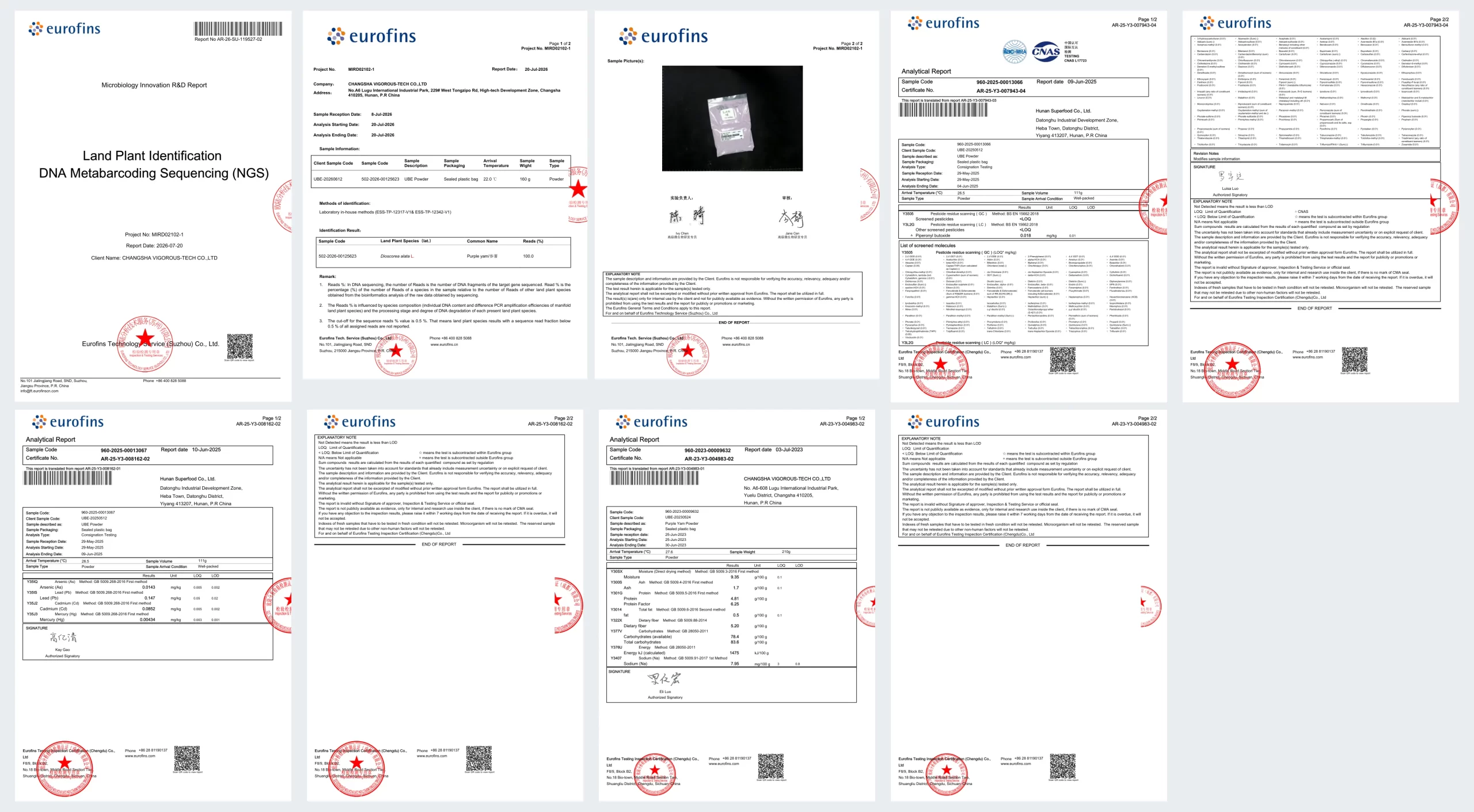

Customers can request copies of the available reports.
The applicability of each report to a particular product, manufacturing site, or production batch should be confirmed during supplier qualification.
11.3 HALAL, Kosher, and Organic Documentation
We can provide relevant certification documentation, including:
Our manufacturing operations are also supported by food safety and quality management certifications, including:
Certification validity and scope should be confirmed using the applicable certificates.
11.4 Two Purple Yam Powder Options
We offer both regular and freeze-dried purple yam powder.
Regular Purple Yam Powder
Freeze-Dried Ube Powder
Our team can help customers evaluate which product is more suitable for their intended applications.
11.5 Flexible Bulk Supply and Technical Support
We support commercial buyers with:
We work with food manufacturers, ingredient distributors, beverage brands, bakery manufacturers, and other commercial customers.
*Looking for a reliable supplier of authentic ube powder? Explore our Purple Yam Powder Manufacturer Guide to learn more about manufacturing capabilities, quality control, certifications, and bulk sourcing solutions.
FAQ 1: How long does purple yam powder last?
The shelf life depends on the product and storage conditions. Our regular and freeze-dried purple yam powders have a declared shelf life of 24 months under their specified storage conditions.
FAQ 2: Does ube powder expire?
Yes. Ube powder has a limited shelf life and should be used according to its applicable expiration date and storage instructions.
FAQ 3: Can purple yam powder last for 2 years?
Yes. Our product documentation specifies a 2-year shelf life for regular and freeze-dried purple yam powder when properly sealed and protected from moisture and direct sunlight.
FAQ 4: Does freeze-dried ube powder last longer?
Not necessarily. Freeze-dried powder may have a lower moisture content, but its shelf life also depends on water activity, packaging, storage conditions, and other factors.
FAQ 5: What is the moisture content of purple yam powder?
Our regular purple yam powder has a moisture specification of NMT 12.0%, while our freeze-dried ube powder has a moisture specification of NMT 8.0%.
FAQ 6: Does purple yam powder need refrigeration?
Properly dried, shelf-stable purple yam powder generally does not require refrigeration unless the manufacturer specifies otherwise.
FAQ 7: Can purple yam powder lose its color during storage?
Yes. Natural anthocyanin pigments can be affected by environmental conditions such as temperature, light, and oxygen.
FAQ 8: Does low moisture content guarantee a longer shelf life?
No. Moisture content alone cannot determine shelf life. Water activity, packaging, processing conditions, and storage environment also matter.
FAQ 9: How can I verify the remaining shelf life of a bulk shipment?
Request the manufacturing date, expiration date, and applicable batch documentation before shipment.
FAQ 10: Can expired purple yam powder still be used?
Expired ingredients should not be used in commercial food manufacturing without an appropriate documented quality assessment and confirmation of compliance with applicable requirements.
FAQ 11: What packaging is used for bulk purple yam powder?
Our standard packaging is 25 kg per paper drum with two inner plastic bags.
FAQ 12: How can I verify purple yam powder authenticity?
Request botanical identification documentation confirming the raw material’s identity as Dioscorea alata.
FAQ 13: What quality documents are available?
We can provide available COAs, botanical identification documentation, pesticide residue testing reports, heavy metal testing reports, nutritional analysis reports, and relevant certification documents.
FAQ 14: Can I request samples before placing a bulk order?
Yes. Commercial customers can contact our team to discuss sample availability and technical evaluation requirements.
FAQ 15: Where can I buy purple yam powder in bulk?
Changsha Vigorous-tech Co., Ltd. supplies regular and freeze-dried purple yam powder for commercial food and beverage applications.
Purple yam powder shelf life is influenced by multiple factors, including moisture content, water activity, temperature, packaging, and pigment stability.
Scientific research provides useful insights into the mechanisms affecting dried food ingredient quality.
However, buyers should also review product-specific documentation rather than relying only on general research findings.
At Changsha Vigorous-tech Co., Ltd., our regular purple yam powder and freeze-dried ube powder have a declared shelf life of 24 months under the specified storage conditions.
We support international customers with product specifications, available testing reports, and flexible purchasing solutions.
For commercial buyers, understanding both the scientific principles and the supplier’s actual product specifications is essential for effective ingredient management.
Looking for a Reliable Purple Yam Powder Manufacturer in China?
Changsha Vigorous-tech Co., Ltd. supplies regular and freeze-dried purple yam powder for commercial food and beverage applications.
We welcome inquiries from:
Contact us to request:
Company: Changsha Vigorous-tech Co., Ltd.
Website: vigorous-tech.com
Correo electrónico: info@vigorous-tech.com
Business Type: Botanical Ingredient Manufacturer & Supplier
Contact our team today to discuss your purple yam powder sourcing requirements.
*Explore our Purple Yam Powder product page to review available specifications, packaging options, and sourcing information, or contact our team for a customized quotation.
The following sources support the general scientific discussion of anthocyanin stability, water activity, and freeze-drying technology.
They should not be interpreted as product-specific shelf-life validation studies for Changsha Vigorous-tech Co., Ltd.
[1] Xue, H., et al. (2024).
Factors affecting the stability of anthocyanins and strategies for improving their stability: A review.
Food Chemistry: X.
DOI: 10.1016/j.fochx.2024.101883
[2] U.S. Food and Drug Administration (FDA).
Water Activity (aw) in Foods.
FDA Inspection Technical Guide.
[3] Chen, Y., et al. (2023).
Updated insights into anthocyanin stability behavior from bases to cases: Why and why not anthocyanins lose during food processing.
Critical Reviews in Food Science and Nutrition, 63(27), 8639–8671.
DOI: 10.1080/10408398.2022.2063250
[4] Al Faruq, A., et al. (2025).
Technological Innovations in Freeze Drying: Enhancing Efficiency, Sustainability, and Food Quality.
Food Engineering Reviews, 17, 859–883.
DOI: 10.1007/s12393-025-09415-8
[5] Zang, et al. (2022).
An updated review on the stability of anthocyanins regarding the interaction with food proteins and polysaccharides.
Comprehensive Reviews in Food Science and Food Safety, 21(5), 4378–4401.
DOI: 10.1111/1541-4337.13026
Product-Specific Technical Documentation
The product specifications and declared shelf-life information discussed in this article are based on available COA documentation supplied by Changsha Vigorous-tech Co., Ltd.
Supporting documents may be requested for supplier qualification and technical review.
No. A6 Lugu International Industrial Park, 229# West Tongzipo Road, High-tech Development Zone, Changsha 410205, Hunan, P.R China
13142031766



We work with business customers and manufacturers. Individual consumer orders are not accepted.

 ES
 EN
 DE
 ZH
 DE_AT
 DE_CH
 FR
 FR_CA
 AF
 JA
 EN_AU
 EN_GB
 EN_CA
 ES_CL
 RU