
Can't find what you need? → Request a Custom Ingredient
PURPLE YAM POWDER
One of China's Leading Purple Yam Powder Manufacturers
720+ MT
Annual Production Capacity
60 MT
Monthly Production Capacity
40+ Countries
Global Export Markets
20+ Years
Botanical Ingredient Manufacturing Experience

Purple yam powder is becoming increasingly popular among food manufacturers, functional food brands, beverage companies, and clean-label product developers looking for naturally colored, plant-based ingredients. Made from purple yam, also known as Dioscorea alata, the powder provides carbohydrates, dietary fiber, minerals, and naturally occurring plant compounds while offering a distinctive purple color.
But what exactly is in purple yam powder?
This guide explains purple yam powder nutrition facts, including calories, carbohydrates, fiber, protein, vitamins, minerals, and naturally occurring pigments. It also explains how processing affects nutritional values and what B2B buyers should consider when sourcing purple yam powder.
Important: Nutrition values can vary significantly depending on the purple yam variety, cultivation conditions, drying method, moisture content, and processing technology. For commercial formulations, buyers should always refer to the supplier’s current specification sheet and laboratory COA.
Purple yam powder is produced by drying and milling purple-fleshed yam, most commonly associated with Dioscorea alata. Purple yam is different from purple sweet potato, although the two ingredients are sometimes confused in the international market.
Purple yam is naturally rich in starch and contains naturally occurring pigments that give the raw material its characteristic purple-to-violet color.
For food manufacturers, purple yam powder can provide several functions at the same time:
Because it is a whole-food-derived powder, its nutritional profile is generally different from highly purified purple yam starch or isolated colorants.
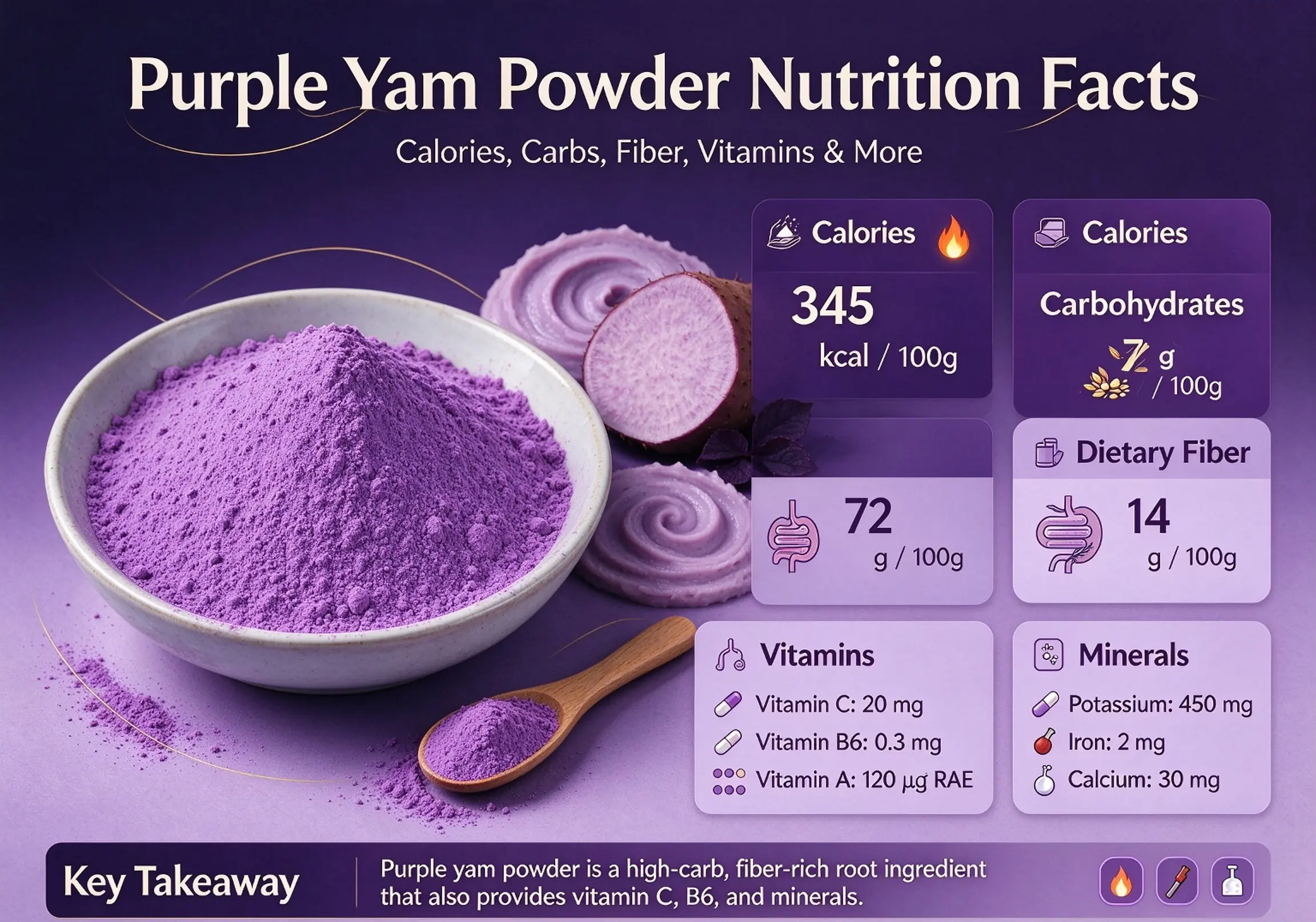
The exact nutritional composition of purple yam powder depends on the raw material and manufacturing process. As a general reference, purple yam powder is primarily a carbohydrate-rich plant ingredient, with smaller amounts of dietary fiber and protein.
A typical nutrition profile may include:
| Nutrient | Typical Characteristics |
|---|---|
| Calories | Mainly supplied by carbohydrates |
| Total Carbohydrates | High |
| Dietary Fiber | Naturally present |
| Protein | Present in smaller amounts |
| Fat | Generally low |
| Potassium | Naturally present |
| Other Minerals | Present in varying amounts |
| Anthocyanins | Naturally occurring in purple varieties |
These figures should be treated as general nutritional characteristics rather than a guaranteed specification.
For B2B applications, a supplier-specific Nutrition Facts panel or nutritional analysis report should be used when calculating the final formulation.
Purple yam powder is relatively energy-dense because the fresh yam loses most of its water during drying.
The majority of its calories come from carbohydrates, particularly starch.
This makes purple yam powder suitable for applications where manufacturers want to add a plant-based carbohydrate ingredient while also introducing the characteristic purple color and flavor of purple yam.
For example, purple yam powder can be incorporated into:
However, the calorie value of a finished product depends on the complete formulation rather than the purple yam powder alone.
Carbohydrates are the dominant macronutrient in purple yam.
Like other edible yam varieties, purple yam naturally contains substantial amounts of starch. During drying, water is removed while much of the carbohydrate content remains, resulting in a concentrated powder.
This makes purple yam powder particularly interesting for manufacturers developing:
Carbohydrate-rich food formulations + natural purple color + recognizable botanical ingredient
The carbohydrate profile can also influence important formulation characteristics such as:
For industrial applications, manufacturers should evaluate the powder’s particle size, moisture content, starch characteristics, and solubility/dispersibility alongside its nutritional composition.
Purple yam naturally contains dietary fiber.
The actual fiber content of commercial powder depends on several factors, including:
A minimally processed whole-food powder generally retains more of the original components of the yam than highly refined starch.
For brands developing high-fiber or plant-based products, purple yam powder can therefore be considered as part of a broader ingredient system.
However, manufacturers should not make a “high in fiber” or similar nutritional claim without confirming that the finished product meets the applicable regulatory requirements in its target market.
Purple yam is not primarily a protein ingredient.
Compared with dedicated plant protein ingredients such as pea protein, soy protein, or rice protein, purple yam powder generally contributes a relatively small amount of protein.
Its main nutritional contribution comes from carbohydrates and other naturally occurring plant components.
Therefore, purple yam powder is best viewed as a botanical food ingredient, rather than a concentrated protein source.
Purple yam is naturally low in fat compared with many nuts, seeds, and oil-rich plant ingredients.
Because commercial purple yam powder is primarily produced from the edible tuber, fat is usually not its dominant macronutrient.
This characteristic makes it suitable for a variety of formulations where manufacturers want to incorporate a colorful plant-based ingredient without significantly increasing the fat content of the recipe.
Purple yam naturally contains several minerals.
Potassium is one of the minerals commonly associated with yam-based foods. Smaller amounts of other minerals may also be present, depending on the raw material and growing conditions.
The mineral profile of commercial purple yam powder can be affected by:
For this reason, commercial buyers who require precise mineral specifications should request a laboratory analysis rather than relying on generic nutritional databases.
One of the most interesting characteristics of purple yam is its naturally purple color.
The purple coloration is associated with anthocyanins, a group of naturally occurring plant pigments found in many purple, red, and blue fruits and vegetables.
Anthocyanins are widely studied in food science and nutrition research because of their antioxidant activity and their role as natural pigments.
For food manufacturers, this creates an additional advantage:
Purple yam can contribute both botanical identity and naturally derived color to a formulation.
However, the anthocyanin concentration is not fixed. It can vary according to:
Therefore, buyers looking for a standardized anthocyanin specification should request a specific analytical value from their supplier.
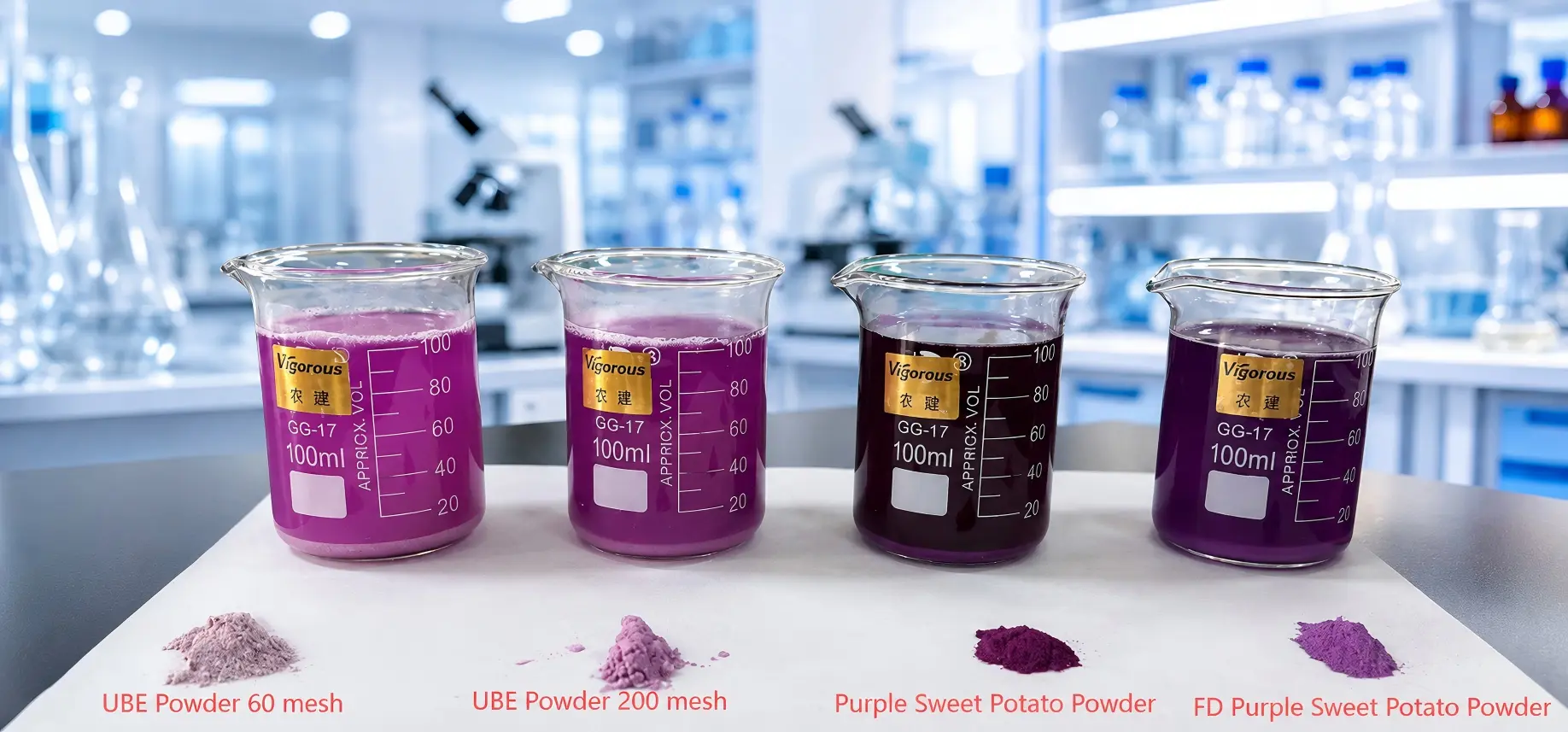
Purple yam powder and purple sweet potato powder are often confused because both can have a vivid purple appearance.
However, they come from different plants.
| Characteristic | Purple Yam Powder | Purple Sweet Potato Powder |
|---|---|---|
| Botanical source | Dioscorea alata | Ipomoea batatas |
| Plant family | Dioscoreaceae | Convolvulaceae |
| Main nutritional component | Carbohydrates/starch | Carbohydrates/starch |
| Natural color | Purple to violet | Purple to deep purple |
| Typical flavor | Yam-like, mildly sweet | Sweet potato-like |
| Common applications | Desserts, beverages, bakery, smoothies | Bakery, beverages, snacks, natural coloring |
| Raw material identification | Important for B2B sourcing | Important for B2B sourcing |
For manufacturers that specifically require authentic purple yam, botanical identification and raw-material traceability are important.
Nutrition facts are not identical across every supplier or batch.
Several factors can influence the final nutritional profile.
1. Purple Yam Variety
Different cultivars naturally have different levels of starch, fiber, protein, minerals, and pigments.
2. Growing Conditions
Soil, climate, irrigation, fertilization, and harvest maturity can all influence the composition of the raw material.
3. Peeling
Some processing methods remove the outer layer of the yam, which can affect the final fiber and mineral profile.
4. Drying Method
Drying temperature and processing time can influence moisture content, color, and some heat-sensitive components.
5. Milling
Particle size affects the physical properties of the powder, including dispersion, texture, and processing performance.
6. Storage
Packaging, humidity, temperature, and storage conditions can affect powder quality over time.
From a formulation perspective, purple yam powder offers a combination of characteristics that makes it interesting for modern food products.
It can provide:
Natural purple color + recognizable botanical source + carbohydrate content + whole-food positioning
Potential applications include:
Bakery
Purple yam powder can be incorporated into:
Beverages
It can be used in:
Desserts
Purple yam is particularly popular in visually distinctive desserts such as:
Snacks
Manufacturers can explore purple yam powder in:
Plant-Based Products
Its botanical origin and distinctive appearance also make it suitable for clean-label and plant-based product concepts.
For B2B buyers, nutritional data is only one part of supplier evaluation.
A reliable purple yam powder supplier should be able to provide documentation covering:
Raw Material Traceability
The supplier should be able to clearly identify the botanical source and origin of the raw material.
For buyers specifically sourcing Dioscorea alata, this is particularly important because purple yam can be confused with purple sweet potato or other purple-colored ingredients.
COA and Specification
A commercial COA may include parameters such as:
Depending on the application, additional testing can also be requested.
Certifications
Depending on the product and market, buyers may look for certifications such as:
Certification requirements vary according to the target market and product application.
At Changsha Vigorous-Tech, we supply purple yam powder for food manufacturers, ingredient distributors, beverage companies, supplement brands, and other B2B customers.
Our focus is not simply on supplying a purple-colored powder. We pay particular attention to raw material authenticity, quality consistency, documentation, and application requirements.
Authentic Purple Yam Raw Material
We can provide supporting cultivation and raw-material information to help customers verify that the ingredient comes from authentic purple yam rather than purple sweet potato.
Flexible MOQ
We support different purchasing volumes for product development, sampling, trial production, and commercial orders.
Quality Documentation
COA and relevant third-party testing reports can be provided according to customer requirements.
Custom Solutions
For customers developing specific food or beverage products, we can discuss particle size, packaging, specifications, and other application requirements.
20+ Years of Manufacturing Experience
With more than 20 years of experience in botanical ingredients and plant-based powders, we understand the quality and documentation requirements of international B2B buyers.
Purple yam powder is primarily a carbohydrate-rich botanical ingredient that also naturally contains dietary fiber, small amounts of protein, minerals, and purple plant pigments such as anthocyanins.
Its nutritional composition is influenced by the yam variety, cultivation conditions, processing method, and moisture content. Therefore, there is no single nutrition profile that applies to every commercial purple yam powder.
For food manufacturers, the most important considerations are:
If you are sourcing authentic Purple Yam Powder (Dioscorea alata) for a commercial food, beverage, bakery, dessert, or plant-based product, contact our team for the latest specification, COA, sample, and B2B quotation.
No. A6 Lugu International Industrial Park, 229# West Tongzipo Road, High-tech Development Zone, Changsha 410205, Hunan, P.R China
13142031766



We work with business customers and manufacturers. Individual consumer orders are not accepted.

 ES
ES  EN
EN  DE
DE  ZH
ZH  DE_AT
DE_AT  DE_CH
DE_CH  FR
FR  FR_CA
FR_CA  AF
AF  JA
JA  EN_AU
EN_AU  EN_GB
EN_GB  EN_CA
EN_CA  ES_CL
ES_CL  RU
RU