
Purple yam powder is a naturally purple-colored ingredient made from purple yam, botanically known as Dioscorea alata. It is widely used in food and beverage applications such as bakery products, desserts, ice cream, beverages, smoothies, instant mixes, fillings, and functional food formulations.
But how exactly is purple yam turned into a stable, fine powder?
The manufacturing process involves much more than simply drying and grinding the root. For commercial-grade purple yam powder, every stage—from raw material identification and cleaning to drying, milling, sieving, and quality control—can affect the final color, flavor, solubility, moisture content, and application performance.
This guide explains how purple yam powder is made on an industrial scale, what happens at each production stage, and what buyers should consider when sourcing it from a manufacturer.
Purple yam, scientifically known as Dioscorea alata, is a tropical tuber known for its naturally vivid purple to violet flesh.
It is also commonly referred to as:
One important point for buyers is that purple yam is not the same ingredient as purple sweet potato.
Purple sweet potato belongs to the Ipomoea batatas species, while purple yam belongs to the Dioscorea genus. Although both can produce purple powders, their botanical identity, flavor profile, texture, starch characteristics, and application performance are different.
For manufacturers and brands, confirming the botanical identity of the raw material is therefore an important part of quality control.
Commercial purple yam powder is generally produced through the following process:
Raw Material Selection → Sorting → Washing → Peeling → Cutting → Drying → Milling → Sieving → Metal Detection → Quality Control → Packaging
The exact process can vary depending on the intended application and product specification.
Let’s examine each stage in detail.
The first step is selecting suitable purple yam (Dioscorea alata) as the raw material.
A professional manufacturer should pay attention to:
Raw material consistency is particularly important because the natural purple color can vary depending on variety, maturity, growing conditions, and processing conditions.
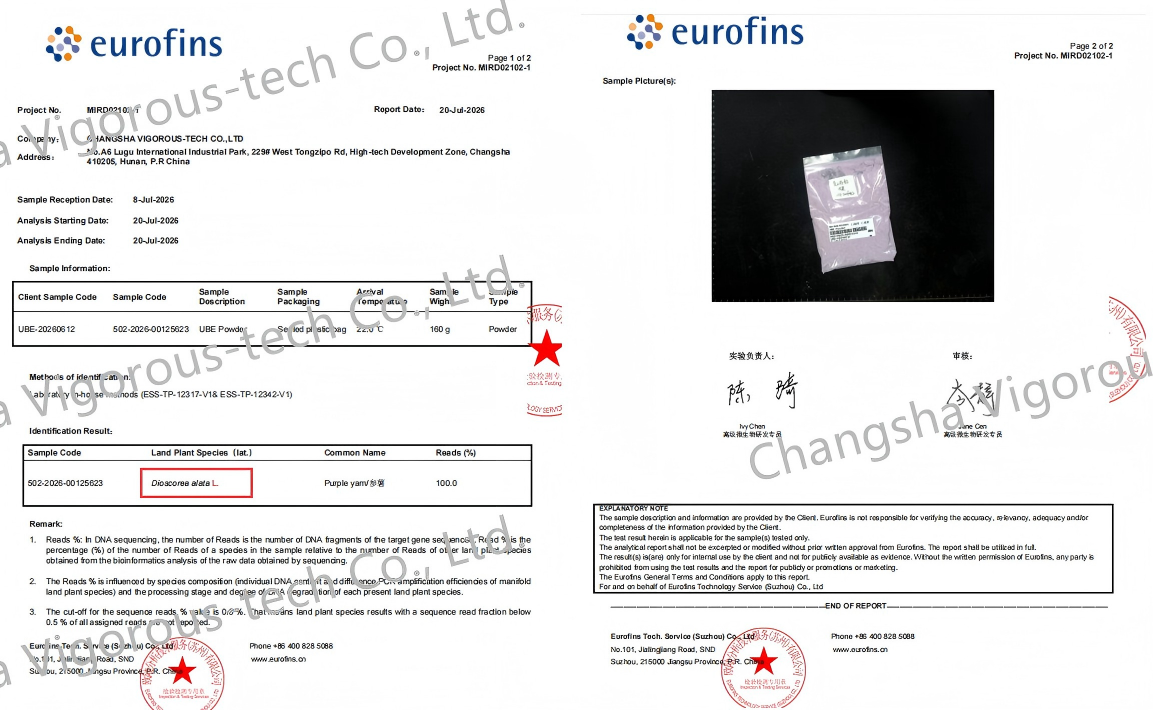
For B2B buyers, asking for documentation confirming the botanical identity and raw material origin can help reduce the risk of receiving a different yam or an undeclared blend.
At Vigorous-Tech, we can provide planting/origin documentation for purple yam raw materials when required, helping customers verify that the raw material is sourced from genuine purple yam rather than being substituted with purple sweet potato or another starch source.
After the raw material arrives at the factory, the yams are inspected and sorted.
Damaged, rotten, moldy, excessively immature, or otherwise unsuitable roots should be removed before processing.
This step may appear simple, but it has a significant influence on the final powder.
Using poor-quality raw materials can lead to:
For industrial production, raw material inspection should therefore be considered the first major quality-control checkpoint.
The selected purple yams are thoroughly washed to remove:
Depending on the production line, mechanical washing systems may be used to improve consistency and processing efficiency.
Effective washing is particularly important for root and tuber ingredients because these crops naturally grow underground and may carry considerable amounts of soil on their surface.
After washing, the outer skin is removed.
Peeling helps reduce unwanted surface materials and produces a cleaner raw material for subsequent processing.
The peeling method can vary according to factory equipment and production volume.
During this stage, manufacturers also need to minimize excessive removal of edible material. Over-peeling can reduce yield, while insufficient peeling may affect the cleanliness and appearance of the final powder.
The cleaned purple yam is then cut into smaller pieces or slices.
Why is slicing necessary?
The main purpose is to create a more uniform size and increase the surface area exposed to the drying process.
Smaller and more uniform pieces generally allow moisture to escape more efficiently than large whole roots.
The thickness of the slices can influence:
Therefore, cutting is not simply a mechanical preparation step—it helps establish consistent drying conditions.
Drying is arguably one of the most critical stages in purple yam powder production.
The objective is to reduce moisture to a stable level while preserving the desired characteristics of the raw material.
Several drying technologies can be used, including:
Hot-Air Drying
Hot-air drying uses controlled heated air to gradually remove moisture.
It is widely applicable to agricultural powders and can provide relatively consistent processing conditions when temperature and airflow are properly controlled.
Low-Temperature Drying
Lower-temperature drying can be used when manufacturers want to place greater emphasis on maintaining the natural color, aroma, and sensory characteristics of the raw material.
However, lower temperatures generally require longer processing times.
Other Specialized Drying Technologies
Depending on the target product, manufacturers may also use other drying technologies.
The appropriate method depends on factors such as:
Why Does Drying Matter So Much?
Poorly controlled drying may result in:
For this reason, temperature, drying time, airflow, and final moisture should be controlled systematically rather than relying only on visual inspection.
Once the dried purple yam reaches the required moisture level, it is transferred to a milling system.
The dried material is mechanically reduced into a fine powder.
Depending on the final specification, manufacturers may adjust:
The goal is to produce a powder with consistent particle size suitable for the customer’s application.
For example:
Bakery applications may require a relatively fine powder for uniform incorporation into dough and batter.
Beverage applications may require additional attention to particle size and dispersion.
Instant food formulations may have different requirements regarding flowability, dispersibility, and mouthfeel.
This is why “purple yam powder” should not be treated as a single standardized product. The appropriate specification depends heavily on its intended application.
After milling, the powder is typically passed through a sieve.
Sieving removes oversized particles and helps create a more uniform powder.
Particle size can influence:
For B2B customers, it is useful to specify the desired particle size or mesh before ordering.
For example, a customer manufacturing beverage powder may have different requirements from a bakery ingredient manufacturer.
A professional supplier should therefore be able to discuss particle size according to the customer’s actual formulation rather than offering only a fixed specification.
After milling and sieving, the powder may pass through appropriate foreign-material control systems, such as metal detection.
This is an important part of food manufacturing because milling equipment contains moving metal components.
Foreign-material control helps improve product safety and supports compliance with food manufacturing requirements.
A complete quality-control system should not depend on one inspection step alone. Preventive controls should be established throughout the production process.
Before the finished purple yam powder is released, quality testing should be performed according to the product specification and applicable market requirements.
Typical quality-control items may include:
Physical Testing
Microbiological Testing
Depending on the specification and market, testing may include:
Contaminant Testing
Depending on customer requirements and destination-market regulations:
A Certificate of Analysis (COA) can then be provided to demonstrate that the batch meets the agreed specification.
For international B2B purchasing, buyers may also request third-party laboratory reports for additional verification.
After passing quality control, purple yam powder is packed into food-grade packaging.
Common packaging formats include:
The appropriate packaging depends on:
For international shipments, moisture protection is particularly important because powdered ingredients can absorb moisture during transportation and storage.
The complete production process can be summarized as:
Genuine Dioscorea alata Raw Material
↓
Sorting & Inspection
↓
Washing
↓
Peeling
↓
Slicing
↓
Controlled Drying
↓
Milling
↓
Sieving
↓
Metal Detection / Foreign-Material Control
↓
Laboratory Testing
↓
Packaging
↓
Finished Purple Yam Powder
This process may be adjusted according to the customer’s required specifications and final application.
Not all purple yam powders are identical.
Several factors can significantly affect the finished product.
1. Botanical Identity
The raw material should be correctly identified as Dioscorea alata when the product is sold as purple yam powder.
This is especially important because purple yam is sometimes confused with purple sweet potato.
2. Raw Material Quality
Fresh, mature, clean raw materials generally provide a better starting point for powder production.
3. Drying Conditions
Drying conditions can influence the final color, flavor, moisture, and stability of the powder.
4. Particle Size
Different applications require different particle-size specifications.
5. Moisture Control
Excessive moisture can contribute to:
6. Storage and Packaging
Even a well-produced powder can deteriorate if it is exposed to excessive humidity, heat, oxygen, or unsuitable storage conditions.
One of the most common sourcing questions is whether purple yam powder and purple sweet potato powder are the same.
They are not.
| Feature | Purple Yam Powder | Purple Sweet Potato Powder |
|---|---|---|
| Botanical identity | Dioscorea alata | Ipomoea batatas |
| Common name | Purple Yam / Ube | Purple Sweet Potato |
| Plant family | Dioscoreaceae | Convolvulaceae |
| Typical flavor | Yam-like, mildly sweet | Sweet potato-like |
| Texture contribution | Starchy and creamy | Starchy |
| Common applications | Desserts, bakery, beverages, ice cream, fillings | Bakery, beverages, snacks, noodles, desserts |
| Raw material verification | Important | Important |
For brands developing products around authentic ube or purple yam, botanical identification should be confirmed before purchasing.
Commercial purple yam powder can be incorporated into a wide range of food products.
Bakery
Purple yam powder can be used in:
Beverages
Potential applications include:
Desserts
Purple yam is particularly suitable for products where its naturally attractive purple appearance can enhance visual appeal.
Applications include:
Confectionery
It can also be explored in:
Functional Food
Purple yam powder can be incorporated into certain functional food formulations depending on the desired nutritional and technical specifications.
However, product claims should always be based on verified nutritional data and comply with the regulations of the target market.
Yes.
For B2B applications, customization can be more valuable than simply purchasing a standard powder.
Depending on the customer’s requirements, manufacturers may discuss specifications such as:
For example, a beverage manufacturer may prioritize fine particle size and good dispersion, while a bakery manufacturer may focus more on color, flavor, and processing behavior.
The best specification is therefore determined by how the ingredient will actually be used.
When sourcing purple yam powder internationally, price should not be the only consideration.
A reliable supplier should be able to answer questions such as:
These questions help buyers distinguish between a genuine ingredient manufacturer and a supplier that simply trades finished powders.
At Changsha Vigorous-Tech Co., Ltd., we focus on botanical extracts, plant powders, fruit and vegetable powders, mushroom ingredients, and other natural food ingredients.
For customers sourcing purple yam powder, we can support the process from raw material verification to finished-product customization.
Our service capabilities include:
Our manufacturing system is supported by certifications including FSSC 22000, ISO 22000, ISO 9001, cGMP, Kosher, and Halal, according to the applicable facility/product scope.
With more than 20 years of experience in botanical ingredients, our goal is not simply to supply a bag of powder. We aim to help international customers identify the right ingredient specification, manage documentation, optimize purchasing, and develop a reliable long-term supply chain.
Is purple yam powder made from fresh purple yam?
Yes. Commercial purple yam powder is generally produced from purple yam tubers that are cleaned, prepared, dried, milled, and sieved.
What is the botanical name of purple yam?
The botanical name commonly used for purple yam is Dioscorea alata.
Is purple yam powder the same as ube powder?
In many food markets, “ube powder” refers to powder made from purple yam, particularly Dioscorea alata. However, buyers should confirm the botanical identity with the supplier because naming conventions can vary between markets.
How is purple yam powder different from purple sweet potato powder?
Purple yam comes from Dioscorea alata, while purple sweet potato comes from Ipomoea batatas. They are different crops with different flavor and processing characteristics.
Why is purple yam powder purple?
The purple color comes from naturally occurring pigments in the yam. The final color can vary according to variety, raw material condition, and processing conditions.
Can purple yam powder be used in beverages?
Yes. It can be used in smoothies, specialty beverages, milk-based drinks, plant-based beverages, and powdered beverage formulations, depending on the required specifications.
What mesh size is available for purple yam powder?
Mesh size can be customized according to the application and production requirements. Buyers should communicate their target particle size before placing a bulk order.
Can you provide a sample before bulk ordering?
Yes. Samples can be arranged for qualified B2B customers to evaluate color, flavor, particle size, and application performance before commercial purchasing.
Can you provide a COA for purple yam powder?
Yes. A COA can be provided according to the agreed product specification. Additional third-party testing can also be discussed when required.
Can purple yam powder be private labeled?
Yes. Customized packaging and private-label solutions can be discussed according to order quantity and market requirements.
How is purple yam powder made?
In simple terms, the process is:
Authentic purple yam → sorting → washing → peeling → slicing → controlled drying → milling → sieving → quality testing → packaging.
However, producing consistent commercial-grade purple yam powder requires much more than simply grinding dried yam.
The botanical identity of the raw material, drying conditions, moisture control, particle size, microbiological safety, contaminant testing, packaging, and application requirements all contribute to the quality of the final ingredient.
For international buyers, working directly with an experienced manufacturer can make it easier to verify the raw material, customize specifications, obtain quality documentation, and develop a stable supply chain.
If you are looking for Purple Yam Powder / Ube Powder made from genuine Dioscorea alata, contact Vigorous-Tech to request a product specification, COA, sample, or customized quotation.
Looking for a reliable Purple Yam Powder manufacturer?
Contact us for samples, specifications, documentation, and B2B pricing.
Recommend related articles
No. A6 Lugu International Industrial Park, 229# West Tongzipo Road, High-tech Development Zone, Changsha 410205, Hunan, P.R China
13142031766



We work with business customers and manufacturers. Individual consumer orders are not accepted.

 ES
ES  EN
EN  DE
DE  ZH
ZH  DE_AT
DE_AT  DE_CH
DE_CH  FR
FR  FR_CA
FR_CA  AF
AF  JA
JA  EN_AU
EN_AU  EN_GB
EN_GB  EN_CA
EN_CA  ES_CL
ES_CL  RU
RU