
Can't find what you need? → Request a Custom Ingredient
PURPLE YAM POWDER
One of China's Leading Purple Yam Powder Manufacturers
720+ MT
Annual Production Capacity
60 MT
Monthly Production Capacity
40+ Countries
Global Export Markets
20+ Years
Botanical Ingredient Manufacturing Experience

Purple yam powder, commonly known as ube powder, is becoming an increasingly popular ingredient in the global food and beverage industry. Its distinctive purple color, mild flavor, and versatility make it suitable for bakery products, beverages, ice cream, confectionery, and other food applications.
However, improper storage can negatively affect the quality of purple yam powder, leading to moisture absorption, clumping, color changes, flavor deterioration, and reduced shelf life.
For food manufacturers, ingredient distributors, and bulk buyers, understanding how to store purple yam powder properly is essential for maintaining product consistency, reducing ingredient waste, and protecting product quality.
In this comprehensive guide, Changsha Vigorous-tech Co., Ltd., an experienced botanical ingredient manufacturer and supplier, explains the best storage practices for purple yam powder, the factors affecting its shelf life, and practical recommendations for commercial applications.
Purple yam powder is produced from purple yam (Dioscorea alata), a tropical tuber widely cultivated in Asia.
It is commonly used as a natural ingredient in food and beverage formulations because of its distinctive appearance, flavor, and processing versatility.
Depending on the manufacturing process, purple yam powder may be produced through:
Different processing methods can influence the powder’s moisture content, particle characteristics, color, flavor, and storage stability.
Common Applications of Poudre d'igname pourpre
Purple yam powder is widely used in:
Beverages: Ube lattes, milk tea, smoothies, and flavored drink mixes.
Bakery Products: Cakes, bread, cookies, pastries, and muffins.
Ice Cream and Desserts: Ice cream, frozen desserts, puddings, and dessert fillings.
Confectionery: Candy, gummies, chocolates, and other sweet products.
Food Ingredient Blends: Dessert premixes, baking mixes, and customized food formulations.
Because these applications require consistent ingredient quality, proper storage is especially important for commercial users.
Purple yam powder is a dehydrated food ingredient. Although removing moisture helps improve storage stability, the powder can still be affected by environmental conditions.
The most important factors include humidity, temperature, oxygen exposure, light, and packaging quality.
2.1 Preventing Moisture Absorption
One of the most common problems during purple yam powder storage is moisture absorption.
When exposed to humid air, the powder may absorb moisture, potentially causing:
For manufacturers using automated powder-handling equipment, clumping can also interfere with ingredient dosing and production efficiency.
Recommendation: Keep purple yam powder in moisture-resistant packaging and minimize exposure to humid air.
2.2 Preserving Its Natural Purple Color
The characteristic purple color of purple yam is associated with naturally occurring anthocyanin pigments.
These compounds can be sensitive to environmental conditions, including temperature, light, oxygen, and pH.
During prolonged or improper storage, the powder may gradually lose some of its original color intensity.
For manufacturers producing ube beverages, bakery products, and desserts, color consistency is an important quality consideration.
Recommendation: Store purple yam powder away from direct sunlight and excessive heat.
2.3 Maintaining Flavor and Aroma
Purple yam powder has a mild, characteristic flavor.
Improper storage may expose the powder to external odors, moisture, and oxidative conditions that affect its sensory characteristics.
Because powders can absorb surrounding odors, storage near strongly scented materials should be avoided.
Recommendation: Store the product in sealed packaging in a clean, dry, odor-free environment.
2.4 Reducing Ingredient Waste
For commercial buyers purchasing 25 kg, 100 kg, or larger quantities, improper storage can result in unnecessary ingredient losses.
Maintaining suitable warehouse conditions helps reduce quality deterioration and supports more consistent manufacturing operations.
For many commercially dried purple yam powders, a cool, dry storage environment is generally appropriate.
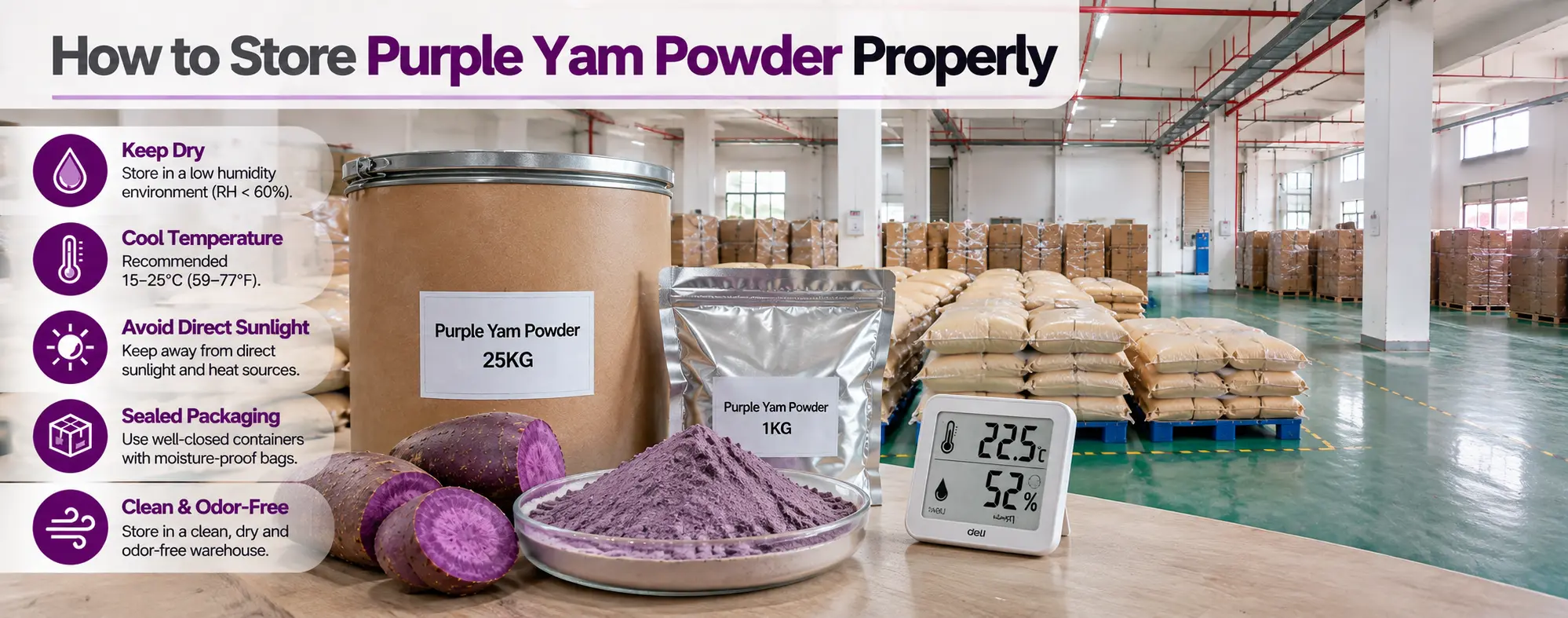
As a practical warehouse guideline, maintaining temperatures around 15–25°C (59–77°F) can help reduce unnecessary exposure to heat.
However, this is a general recommendation rather than a universal validated storage specification.
The appropriate temperature depends on the product’s processing method, moisture content, packaging, and manufacturer-provided stability data.
Why Should High Temperatures Be Avoided?
Prolonged exposure to elevated temperatures may accelerate quality changes, including:
For this reason, purple yam powder should not be stored near heating equipment, steam pipes, or areas exposed to direct sunlight.
Should Purple Yam Powder Be Refrigerated?
Refrigeration is not normally necessary for a properly dried, shelf-stable purple yam powder unless the manufacturer specifies refrigerated storage.
Refrigeration may also introduce condensation risks when cold packaging is opened in a warm, humid environment.
If refrigerated storage is required, the packaging should remain sealed until the product has equilibrated appropriately with the surrounding environment.
Important: Always follow the storage instructions provided on the product label or technical specification sheet.
Humidity is one of the most important factors affecting the storage performance of dried food powders.
Purple yam powder may absorb moisture when exposed to humid environments.
This can affect powder flowability, texture, and stability.
Recommended Humidity Conditions
For commercial warehousing, maintaining a relatively dry environment is advisable.
A relative humidity below approximately 60% can serve as a practical general target, although this is not a validated requirement for every purple yam powder formulation.
In particularly humid climates, additional humidity control may be necessary.
How to Prevent Moisture-Related Problems
Food manufacturers and distributors should consider the following practices:
For large-scale users, maintaining consistent warehouse conditions can help reduce storage-related quality variations.
Packaging plays a critical role in protecting purple yam powder during transportation and storage.
The ideal packaging should provide an appropriate barrier against moisture, oxygen, light, and contamination.
5.1 Aluminum Foil Bags
High-barrier laminated aluminum foil bags are commonly used for dried botanical powders.
Depending on their construction and sealing quality, they can provide protection against:
They are suitable for smaller commercial packaging formats and sample quantities.
5.2 Bulk Packaging
For industrial buyers, purple yam powder is commonly supplied in larger packaging formats.
A typical commercial configuration may include:
25 kg per carton or drum, with a sealed food-grade inner liner.
Actual packaging specifications should be confirmed with the supplier.
The inner liner helps protect the powder from environmental exposure, while the outer packaging provides additional physical protection during transportation.
5.3 Customized Packaging
Different customers may require different packaging solutions.
For example:
Changsha Vigorous-tech Co., Ltd. supports flexible packaging solutions based on customer requirements and order quantities.
One of the most frequently asked questions from buyers is:
What is the shelf life of purple yam powder?
The answer depends on several factors, including:
Some commercially manufactured dried purple yam powders may carry a shelf life of approximately 12–24 months under specified storage conditions.
However, this range should not be treated as a guaranteed shelf life for every product.
The actual shelf life must be supported by the manufacturer’s product-specific stability assessment and labeling.
Does Freeze-Dried Poudre d'igname pourpre Last Longer?
Freeze-drying removes water under low-temperature conditions and can help preserve certain heat-sensitive product characteristics.
However, freeze-dried purple yam powder does not automatically have a longer shelf life than hot-air-dried powder.
Shelf life also depends on residual moisture, water activity, packaging barriers, and storage conditions.
Buyers should compare the actual specifications and stability information of different products rather than relying on the drying method alone.
How Can Buyers Verify Shelf Life?
Before purchasing purple yam powder in bulk, request:
These documents help buyers evaluate whether a product is suitable for their inventory and production requirements.
Once the original packaging has been opened, the powder becomes more vulnerable to environmental exposure.
Proper handling is therefore essential.
Step 1: Minimize Exposure to Air
Open the package only when necessary.
Avoid leaving the powder exposed to ambient air for extended periods.
Step 2: Use Clean and Dry Equipment
Always use clean, dry scoops and measuring tools.
Wet utensils can introduce moisture into the powder.
Step 3: Reseal the Packaging
After removing the required quantity, reseal the original packaging immediately.
If the original packaging cannot be adequately resealed, transfer the remaining powder to a clean, dry, food-grade airtight container with suitable barrier properties.
Step 4: Store Away from Heat and Light
Keep the resealed powder in a cool, dry location away from direct sunlight.
Step 5: Maintain Traceability
For commercial manufacturing, record:
The allowable use period after opening should follow the supplier’s instructions or the manufacturer’s validated internal procedures.
Before using stored purple yam powder, buyers should inspect its condition.
Potential warning signs include:
8.1 Unusual Odor
A sour, musty, or otherwise abnormal smell may indicate quality deterioration or contamination.
8.2 Excessive Clumping
Significant clumping may indicate moisture exposure.
However, minor clumping alone does not necessarily mean that the product is unsafe or spoiled.
8.3 Visible Mold
Any visible mold growth is a serious warning sign.
Affected powder should not be used.
8.4 Unexpected Color Changes
Substantial discoloration may indicate pigment degradation or other quality changes.
However, color changes alone cannot reliably determine microbiological safety.
8.5 Damaged Packaging
Broken seals, punctured liners, water damage, or evidence of pest activity may compromise product quality.
Important: Appearance and odor checks cannot establish food safety. If contamination or improper storage is suspected, quarantine the affected batch and conduct an appropriate quality assessment before use.
Commercial buyers face additional challenges because large quantities may remain in warehouses for extended periods.
Effective inventory management is therefore essential.
9.1 Use FEFO Inventory Management
FEFO stands for First Expired, First Out.
Under this system, batches with earlier expiration dates are used before those with later expiration dates.
This approach helps reduce the risk of holding ingredients beyond their approved shelf life.
9.2 Keep Products Off the Floor
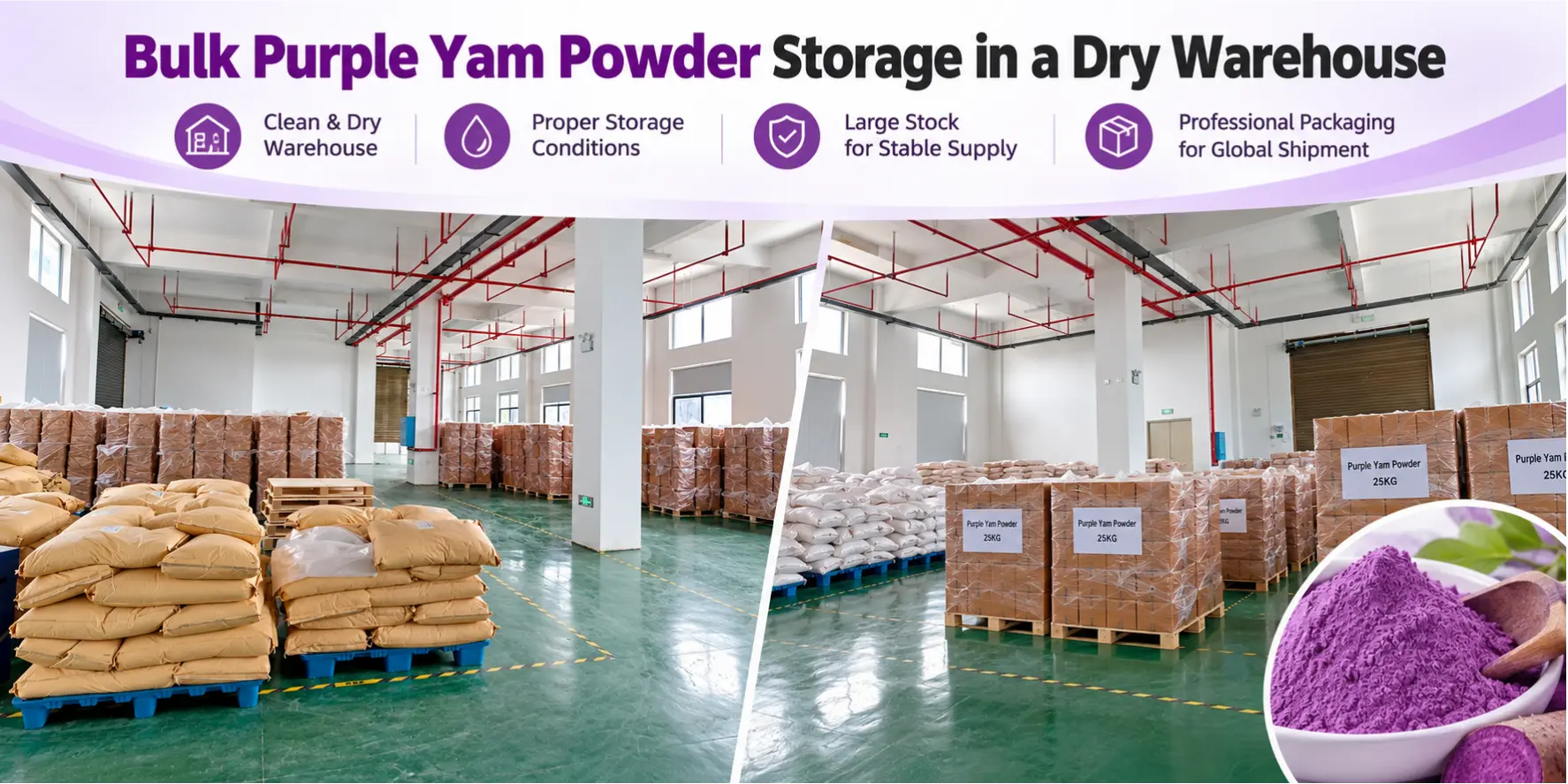
Store cartons, bags, and drums on clean pallets or appropriate warehouse racking.
This helps reduce exposure to floor moisture and supports warehouse cleaning and inspection.
9.3 Avoid Direct Sunlight
Do not position powder near windows or other locations where direct sunlight may cause localized heating.
9.4 Monitor Warehouse Conditions
Temperature and humidity monitoring can help identify unsuitable storage conditions.
Where appropriate, warehouse managers should maintain environmental monitoring records.
9.5 Inspect Incoming Shipments
Upon receiving bulk purple yam powder, check:
If the product has been exposed to moisture or other unsuitable conditions during transportation, further evaluation may be necessary.
Purple yam powder and purple sweet potato powder are frequently confused in the international ingredient market.
Although both products have purple coloration, they come from different botanical sources.
| Comparison | Poudre d'igname pourpre | Purple Sweet Potato Powder |
|---|---|---|
| Botanical source | Dioscorea alata | Ipomoea batatas |
| Common name | Ube Powder | Purple Sweet Potato Powder |
| Natural pigments | Anthocyanins | Anthocyanins |
| Main storage concern | Moisture, heat, light, oxygen | Moisture, heat, light, oxygen |
| Typical storage environment | Cool, dry, sealed | Cool, dry, sealed |
| Refrigeration | Usually unnecessary for shelf-stable dried powder | Usually unnecessary for shelf-stable dried powder |
| Commercial applications | Ube desserts, beverages, bakery | Beverages, bakery, snacks, food coloring applications |
Both powders generally benefit from moisture-resistant packaging and controlled storage conditions.
However, differences in pigment composition, manufacturing methods, and formulation can influence their storage stability.
Buyers should evaluate each product according to its own specifications.
Yes.
The natural color of purple yam powder is one of its most commercially important characteristics.
However, anthocyanin pigments can be affected by several factors.
Temperature
Higher temperatures may accelerate pigment degradation during prolonged storage.
Light
Light exposure can contribute to changes in pigment stability.
Oxygen
Oxygen exposure may promote oxidative reactions that affect color quality.
Moisture
Excessive moisture can influence powder stability and potentially contribute to quality deterioration.
Product Formulation and pH
When purple yam powder is incorporated into beverages or other food products, the final color can also depend on the formulation’s pH and other ingredients.
For example, an acidic beverage may display a different purple or reddish-purple shade than a neutral dairy-based formulation.
For food manufacturers, storage stability and application stability should be evaluated separately.
A powder that maintains its color during warehouse storage may still behave differently when incorporated into a finished food product.
Proper storage begins with selecting a reliable supplier.
A qualified manufacturer should not only supply purple yam powder but also provide information that helps customers maintain product quality throughout the supply chain.
12.1 Verify Botanical Authenticity
Authentic purple yam powder should be produced from Dioscorea alata.
Buyers should confirm the botanical identity of the raw material.
Purple yam powder should not be confused with purple sweet potato powder or other purple-colored botanical powders.
12.2 Review Product Specifications
Important quality parameters may include:
12.3 Request Quality Documentation
Depending on the product and target market, buyers may request:
12.4 Evaluate Packaging and Logistics
For international buyers, packaging quality and transportation conditions can affect product integrity.
A reliable supplier should provide suitable export packaging and clear handling instructions.
12.5 Assess Technical Support
Food manufacturers may require additional support when developing products containing purple yam powder.
For example, they may need assistance with:
Working with an experienced supplier can simplify ingredient evaluation and product development.

Choosing a reliable purple yam powder manufacturer is not just about competitive pricing. For food manufacturers, ingredient distributors, and international buyers, product authenticity, quality documentation, storage stability, and supply chain reliability are equally important.
Changsha Vigorous-tech Co., Ltd., established in 2005, is an experienced Chinese manufacturer and supplier of botanical ingredients, including Purple Yam Powder (Ube Powder) and Freeze-Dried Purple Yam Powder.
With over 20 years of industry experience, we provide commercial customers with quality documentation, flexible sourcing solutions, and technical support.
13.1 Authentic Purple Yam Powder with Botanical Identification
One of the biggest concerns in the international ube powder market is product authenticity.
Purple Yam (Dioscorea alata) is sometimes confused with Purple Sweet Potato (Ipomoea batatas), although they are botanically different ingredients.
To help customers verify the botanical identity of our purple yam powder, we can provide a species identification report.
Botanical Identification Report Number: MIRD02102-1
This documentation helps buyers verify the botanical identity of the raw material and supports ingredient traceability.
For food manufacturers developing authentic ube products, verifying the botanical source is an important step in ingredient qualification.
13.2 Third-Party Testing Reports and Quality Documentation
At Changsha Vigorous-tech Co., Ltd., we understand that international buyers need reliable documentation to evaluate ingredient quality.
We can provide the following testing reports for purple yam powder:
| Testing Document | Report Number | Purpose |
|---|---|---|
| Botanical Identification Report | MIRD02102-1 | Supports verification of the botanical identity of purple yam |
| Pesticide Residue Testing Report | AR-25-Y3-007943-04 | Provides pesticide residue testing information |
| Heavy Metal Testing Report | AR-25-Y3-008162-02 | Provides heavy metal testing information |
| Nutritional Analysis Report | AR-23-Y3-004983-02 | Provides nutritional composition information |
| Certificate of Analysis (COA) | Batch-specific | Provides product specifications and available batch test results |
These documents help commercial buyers evaluate product quality, traceability, and suitability for their intended applications.
Customers may request copies of the relevant reports and verify their authenticity and scope with the issuing laboratories.
Please note that report applicability, tested parameters, and compliance with specific market requirements should be evaluated according to the relevant product and batch.
13.3 HALAL, Kosher, Organic and Factory Certifications
In addition to product testing reports, we can provide relevant certification documentation to support customers’ sourcing and supplier qualification processes.
Available documentation includes:
These certifications and supporting documents help customers assess manufacturing practices and meet different sourcing requirements.
Certification validity, applicable products, and certified manufacturing sites should be confirmed through the corresponding certificates.
Our team can assist customers in obtaining the relevant documentation for their purchasing evaluations.
13.4 Two Poudre d'igname pourpre Options for Different Applications
We offer different purple yam powder solutions to meet the needs of food manufacturers, beverage producers, and ingredient distributors.
Based on our product specifications and available COA documentation, customers can evaluate the following options:
| Spécifications | Regular Purple Yam Powder | Freeze-Dried Purple Yam Powder |
|---|---|---|
| Product Name | Ube Powder | Freeze-Dried UBE Powder |
| Botanical Name | Dioscorea alata | Dioscorea alata |
| Plant Part | Root | Root |
| Apparence | Fine light purple powder | Fine purple powder |
| Particle Size | NLT 90% through 60 mesh | NLT 90% through 80 mesh |
| Moisture Specification | NMT 12.0% | NMT 8.0% |
| Freeze-Dried Batch Moisture Result | — | 4.88% |
| Ash Specification | NMT 12.0% | NMT 5.0% |
| Durée de conservation | 2 years under specified storage conditions | 2 years under specified storage conditions |
| Packaging | 25 kg/drum | 25 kg/drum |
NLT: Not Less Than
NMT: Not More Than
The freeze-dried product has a finer specified particle size and a lower moisture limit than the regular product.
However, the actual performance of each powder depends on its manufacturing process, formulation, and intended application.
We recommend that customers evaluate samples before selecting the most suitable product for large-scale production.
13.5 Professional Purple Yam Powder Storage Recommendations Based on Our COA
Proper storage is essential for maintaining the quality of purple yam powder during international transportation, warehousing, and commercial production.
According to our available COA documents, both regular and freeze-dried purple yam powder should be stored in well-closed containers, protected from moisture and direct sunlight.
Our product documentation specifies the following:
Regular Purple Yam Powder
Freeze-Dried Purple Yam Powder
The freeze-dried product’s lower moisture specification does not eliminate the need for moisture protection.
Both products should be handled carefully to minimize moisture absorption during storage and processing.
Recommended Warehouse Storage Practices
1. Keep the Packaging Properly Sealed
Our standard bulk packaging consists of paper drums with two inner plastic bags.
Keep the inner bags properly sealed when the powder is not in use to minimize exposure to ambient moisture.
2. Store in a Cool, Dry Environment
Avoid storing purple yam powder in areas exposed to excessive heat or humidity.
As a general warehouse management guideline, temperatures around 15–25°C and relative humidity below approximately 60% may be considered where practical.
These are general recommendations, not additional validated specifications stated in our COA.
3. Protect the Powder from Direct Sunlight
Purple yam contains naturally occurring anthocyanin pigments that contribute to its characteristic purple color.
Avoiding prolonged exposure to direct sunlight and excessive heat can help protect the powder’s appearance during storage.
4. Store Bulk Packaging on Pallets
For commercial warehousing, we recommend keeping packaged purple yam powder on clean, dry pallets rather than directly on the warehouse floor.
This helps reduce exposure to floor moisture and facilitates warehouse cleaning and inventory management.
5. Reseal Immediately After Opening
After removing the required quantity, close the inner packaging promptly.
Always use clean and dry handling equipment to minimize moisture introduction.
6. Follow the Product Shelf Life
Our available product documentation specifies a shelf life of 2 years under the stated sealed storage conditions.
Customers should follow the expiration date and storage instructions applicable to their purchased batch.
For opened products, storage duration should be determined according to appropriate handling procedures and product-specific quality requirements.
13.6 Reliable Bulk Supply and Customized Services
As an experienced botanical ingredient supplier, we understand the different purchasing requirements of international food manufacturers and distributors.
Our services include:
Flexible Minimum Order Quantities
We support different purchasing volumes to accommodate product development, trial production, and commercial procurement.
Bulk Supply
We provide purple yam powder for commercial manufacturing and ingredient distribution.
Customized Packaging
Packaging solutions can be discussed according to customer requirements.
Product Samples
Commercial customers can request samples for ingredient evaluation and formulation testing.
Technical Documentation
Our team can assist with COAs, product specifications, and available third-party testing reports.
Global Logistics Support
We support international shipping arrangements and export documentation requirements.
One-Stop Ingredient Sourcing
In addition to purple yam powder, we supply purple sweet potato powder and other botanical ingredients for food and beverage applications.
13.7 Request Purple Yam Powder Samples and Quality Documents
Are you looking for a reliable purple yam powder manufacturer with verifiable quality documentation?
Changsha Vigorous-tech Co., Ltd. welcomes inquiries from food manufacturers, ingredient distributors, beverage companies, bakery manufacturers, and other commercial buyers.
We can help you evaluate:
FAQ 1: How should purple yam powder be stored?
Store purple yam powder in tightly sealed, moisture-resistant packaging in a cool, dry place away from direct sunlight, heat, and strong odors. Follow the manufacturer’s product-specific storage instructions.
FAQ 2: Does purple yam powder need refrigeration?
Most properly dried, shelf-stable purple yam powders do not require refrigeration. However, specific storage requirements depend on the product formulation and manufacturer recommendations.
FAQ 3: How long can purple yam powder be stored?
Some commercial products have a stated shelf life of 12–24 months under specified conditions. The actual shelf life should be verified through product-specific documentation.
FAQ 4: Can purple yam powder go bad?
Yes. Improper storage may lead to moisture absorption, quality deterioration, or contamination.
FAQ 5: Why does purple yam powder become clumpy?
Clumping may occur when the powder absorbs moisture from the surrounding environment. Powder composition and particle characteristics can also affect clumping behavior.
FAQ 6: Can purple yam powder lose its purple color?
Yes. Prolonged exposure to heat, light, oxygen, or unsuitable storage conditions may contribute to color deterioration.
FAQ 7: Can purple yam powder be frozen?
Freezing is generally unnecessary for shelf-stable dried purple yam powder. Temperature fluctuations and condensation during thawing can introduce additional moisture risks.
FAQ 8: What is the best packaging for bulk purple yam powder?
Moisture-resistant, food-grade packaging with suitable barrier properties is recommended. Common commercial options include sealed inner liners combined with protective cartons or drums.
FAQ 9: How should opened purple yam powder be stored?
Reseal the packaging immediately after use, protect it from moisture, and follow the manufacturer’s instructions or validated internal handling procedures.
FAQ 10: Is freeze-dried purple yam powder easier to store?
Freeze-dried powder can have favorable quality characteristics, but its storage stability still depends on moisture content, packaging, and environmental conditions.
FAQ 11: Can I use purple yam powder after its expiration date?
Commercial food manufacturers should follow their approved quality procedures and applicable regulations. Expired ingredients should not be used without an appropriate, documented quality assessment.
FAQ 12: How can I check the quality of stored purple yam powder?
Review packaging integrity, appearance, odor, batch information, and storage records. Laboratory testing may be necessary to evaluate suspected deterioration or contamination.
FAQ 13: What is the difference between purple yam powder and purple sweet potato powder?
Purple yam powder comes from Dioscorea alata, while purple sweet potato powder comes from Ipomoea batatas. They have different botanical identities and may exhibit different functional and sensory properties.
FAQ 14: Can purple yam powder be used in beverages?
Yes. Purple yam powder is used in ube-flavored beverages, smoothies, milk tea, and other drink formulations. Its dispersibility and stability should be evaluated for the intended application.
FAQ 15: Where can I buy purple yam powder in bulk?
Commercial buyers can contact Changsha Vigorous-tech Co., Ltd. to discuss purple yam powder specifications, bulk pricing, minimum order quantities, packaging, and available quality documentation.
Understanding how to store purple yam powder is essential for preserving its appearance, flavor, and overall quality.
The most important principles are straightforward:
For commercial buyers, choosing a reliable manufacturer is equally important.
High-quality raw materials, suitable processing methods, protective packaging, and accurate technical documentation all contribute to effective ingredient management.
At Changsha Vigorous-tech Co., Ltd., we support food manufacturers, ingredient distributors, and commercial brands with purple yam powder sourcing and customized ingredient solutions.
Changsha Vigorous-tech Co., Ltd. provides purple yam powder for commercial food and beverage applications.
Whether you are developing a new ube beverage, expanding your bakery product range, or sourcing purple yam powder for industrial production, our team can help you evaluate suitable ingredient solutions.
Contact us for:
Company: Changsha Vigorous-tech Co., Ltd.
Website: vigorous-tech.com
Courriel : info@vigorous-tech.com
Business Type: Botanical Ingredient Manufacturer & Supplier
We focus on serving business customers, including food manufacturers, ingredient distributors, and commercial brands.
Contact our team today to discuss your purple yam powder sourcing requirements.
Purple Yam Powder Wholesale Guide: How to Source, Evaluate and Buy in Bulk
Purple Yam Powder Nutrition Facts: Calories, Carbs, Fiber, Vitamins & More
How Is Purple Yam Powder Made? A Complete Guide to the Manufacturing Process
Purple Yam Powder Applications: A Complete Guide for Food, Beverage, Bakery, Supplements & More
Purple Yam Powder Benefits: Nutrition, Anthocyanins, Digestive Health & Applications
No. A6 Lugu International Industrial Park, 229# West Tongzipo Road, High-tech Development Zone, Changsha 410205, Hunan, P.R China
13142031766



We work with business customers and manufacturers. Individual consumer orders are not accepted.

 FR
 EN
 DE
 ZH
 DE_AT
 DE_CH
 ES
 FR_CA
 AF
 JA
 EN_AU
 EN_GB
 EN_CA
 ES_CL
 RU