
Can't find what you need? → Request a Custom Ingredient
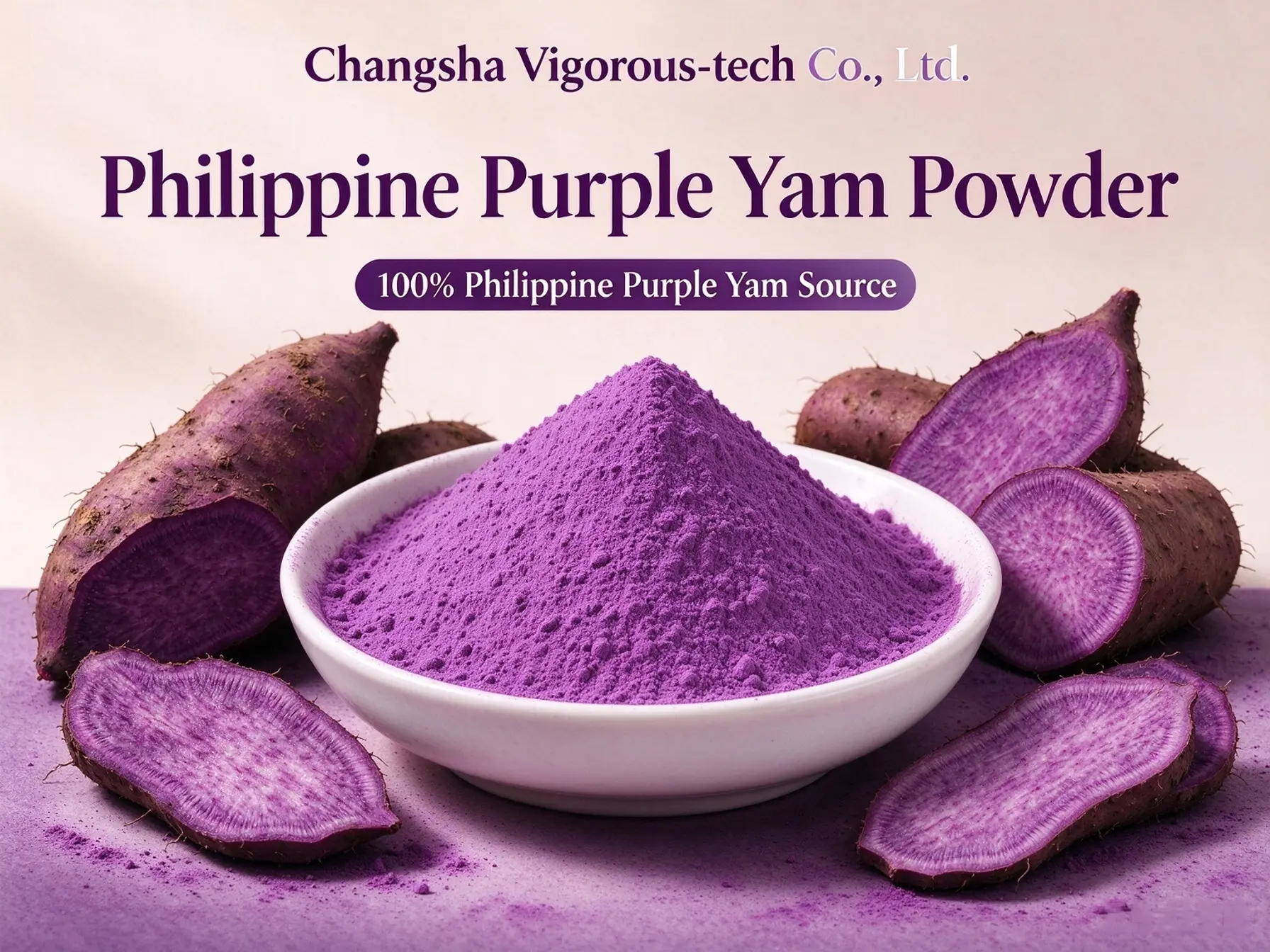
PURPLE YAM POWDER
One of China's Leading Purple Yam Powder Manufacturers
720+ MT
Annual Production Capacity
60 MT
Monthly Production Capacity
40+ Countries
Global Export Markets
20+ Years
Botanical Ingredient Manufacturing Experience

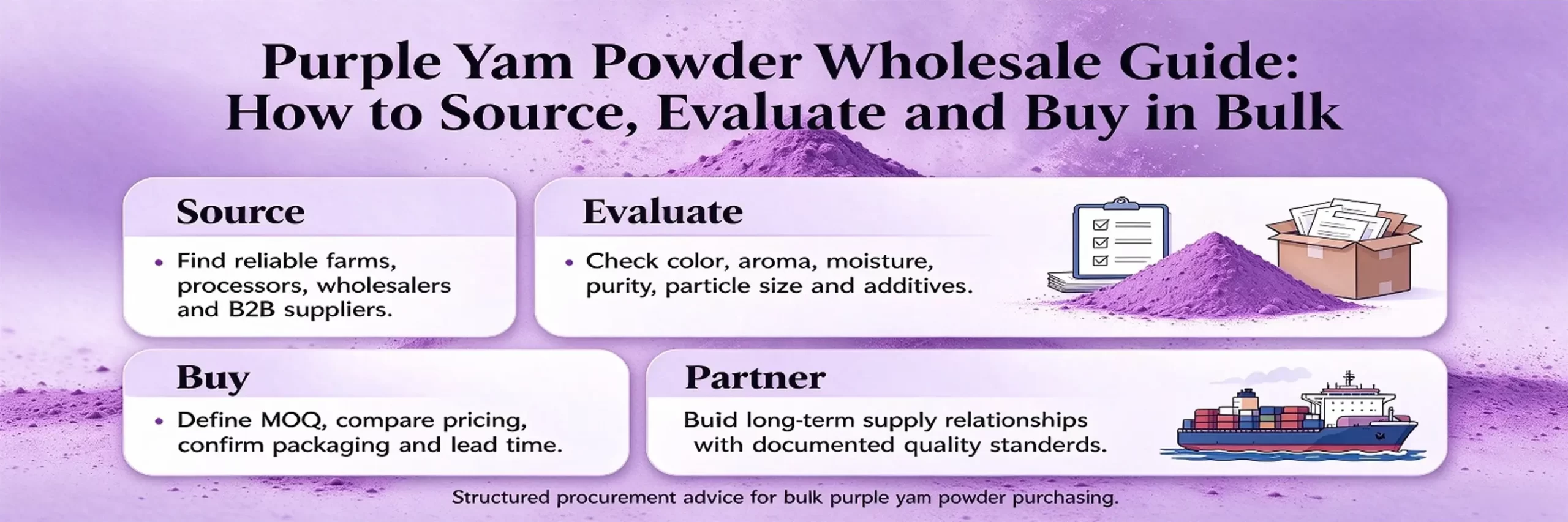
Purple yam powder has become an increasingly interesting ingredient for food manufacturers, beverage companies, supplement brands, bakery producers, and natural color ingredient buyers looking for plant-based ingredients with a distinctive purple appearance.
However, buying purple yam powder wholesale is not simply a matter of comparing prices per kilogram.
For B2B buyers, the more important questions are:
This Purple Yam Powder Wholesale Guide explains what professional buyers should evaluate before placing a bulk order and how to choose a reliable purple yam powder supplier.
Purple yam powder is a dried and powdered ingredient made from purple-fleshed yam varieties.
Purple yam is commonly associated with Dioscorea alata, although the exact botanical identity should always be confirmed with the supplier according to the raw material source.
The fresh tuber naturally contains purple pigments and starch, giving the resulting powder its characteristic purple-to-violet appearance.
Depending on the production process and raw material, commercial purple yam powder may be used as:
For manufacturers, the most important point is that “purple yam powder” and “purple sweet potato powder” should not automatically be treated as the same ingredient.
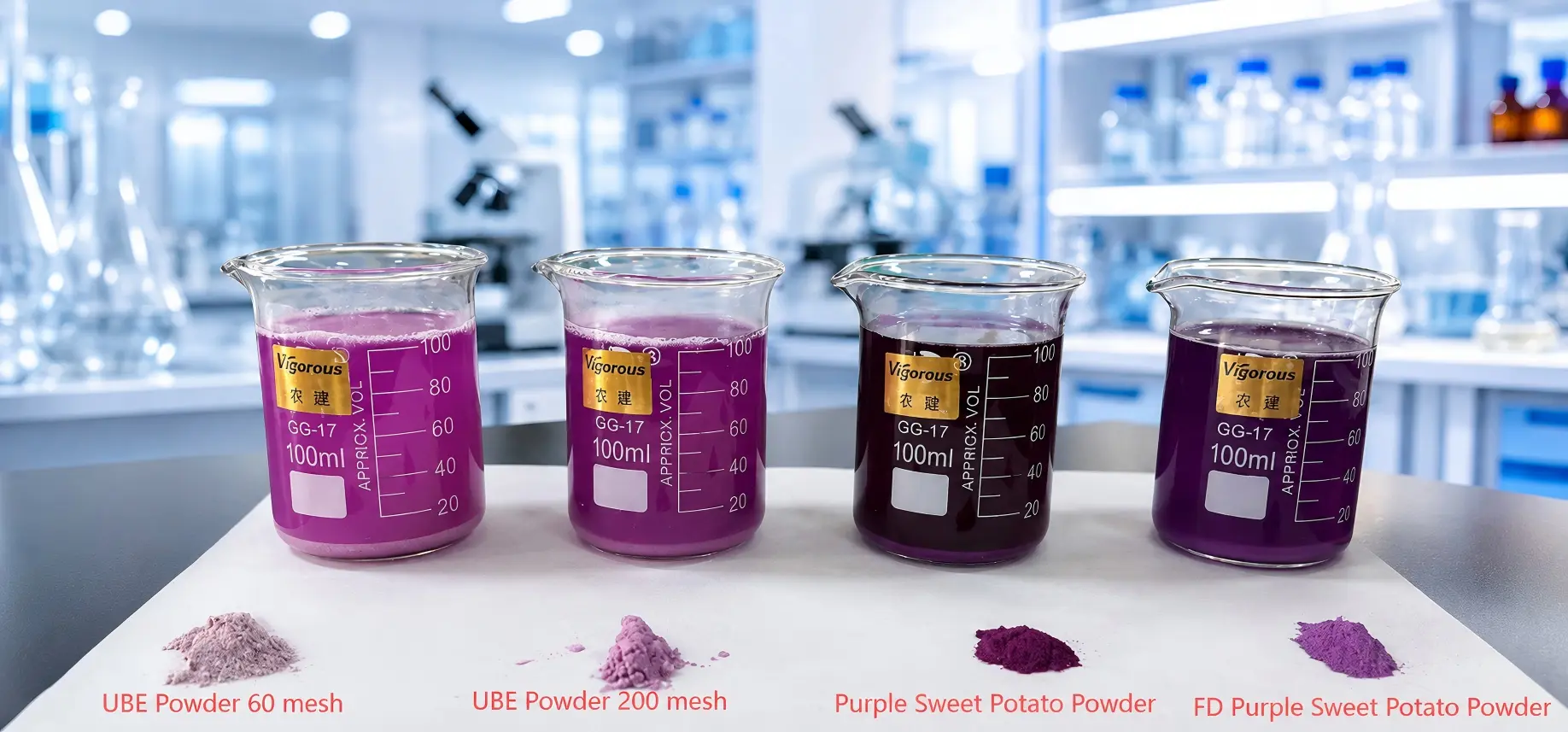
One of the first things a professional buyer should clarify is the identity of the raw material.
Purple yam and purple sweet potato are different plants and should not be used interchangeably when a formulation requires a specific botanical ingredient.
| Feature | 紫山药粉 | Purple Sweet Potato Powder |
|---|---|---|
| Botanical source | Commonly Dioscorea alata | Ipomoea batatas |
| Plant family | Dioscoreaceae | Convolvulaceae |
| Main composition | Starch and naturally occurring plant components | Starch and anthocyanin-rich components |
| 外观 | Purple to violet, depending on variety and processing | Purple to reddish-purple |
| Typical applications | Desserts, bakery, beverages, food mixes | Beverages, bakery, noodles, natural color applications |
| Flavor profile | Mild, earthy, yam-like | Mild, slightly sweet |
| Buyer priority | Authentic botanical identity | Color consistency and anthocyanin profile |
For a food manufacturer developing a product around the identity of ube or purple yam, substituting purple sweet potato may change:
Therefore, buyers should request the botanical name and raw material documentation before making a large purchase.
When sourcing purple yam powder in bulk, price should be only one part of the evaluation.
A professional supplier evaluation should cover at least six areas:
1. Raw Material Authenticity
Can the supplier demonstrate where the purple yam comes from?
2. Processing Capability
Does the manufacturer control drying, milling, sieving, and packaging?
3. Quality Consistency
Can different batches maintain similar color, moisture, particle size, and sensory characteristics?
4. Testing & Documentation
Can the supplier provide COA and relevant third-party testing?
5. Supply Capacity
Can the supplier support your expected monthly or annual volume?
6. B2B Service Capability
Can the supplier handle customized packaging, documentation, samples, and export requirements?
This is especially important when purple yam powder is being used in a commercial product rather than for small-scale food preparation.
Authenticity is one of the most important issues when purchasing purple yam powder wholesale.
A product labeled “Purple Yam Powder” should have a clearly defined raw material source.
Ask for the botanical name
A serious supplier should be able to identify the raw material used for the product.
For buyers who need Dioscorea alata, the supplier should clearly state the botanical source rather than simply using a marketing name such as “purple root powder.”
Ask about cultivation
Raw material origin can affect:
For commercial procurement, it is useful to understand whether the supplier works with contracted farms, agricultural bases, or controlled cultivation resources.
Request supporting documentation
Depending on your application and market, useful documents may include:
For buyers specifically concerned about authentic purple yam, documentation supporting the cultivation and botanical source can provide an additional level of confidence.
Understanding the manufacturing process can help buyers evaluate whether a supplier has genuine production capabilities.
A typical production process may include:
Raw Material Selection → Cleaning → Cutting/Slicing → Drying → Milling → Sieving → Quality Control → Metal Detection → Packaging → Finished Product Storage
Step 1: Raw Material Selection
Fresh purple yam is selected according to maturity, appearance, color, and quality requirements.
Step 2: Cleaning
The raw material is cleaned to remove soil and other foreign materials.
Step 3: Cutting
The yam is cut into suitable pieces to facilitate efficient drying.
Step 4: Drying
Controlled drying reduces moisture and improves storage stability.
The drying process is particularly important because excessive heat can affect:
Step 5: Milling
The dried material is milled into powder.
The milling process can be adjusted according to the intended application.
Step 6: Sieving
The powder can be sieved to achieve a relatively consistent particle size.
Step 7: Quality Control
Finished powder should be checked against the agreed specification.
Step 8: Packaging
Bulk packaging is selected according to the buyer’s requirements and transportation conditions.
For large-scale procurement, buyers should ask suppliers not only for a product photo but also for information about the actual production process and quality control system.
There is no single specification suitable for every application.
Before requesting a quotation, B2B buyers should define their requirements.
Important parameters may include:
| Specification | Why It Matters |
|---|---|
| Botanical source | Confirms raw material identity |
| 外观 | Helps control batch consistency |
| Color | Important for finished product appearance |
| Flavor | Important for food and beverage applications |
| Moisture | Affects storage stability |
| Particle size / Mesh | Determines dispersion and processing behavior |
| Microbiology | Important for food safety |
| Heavy metals | Required for many commercial applications |
| Pesticide residues | Important for food and international markets |
| Packaging | Affects storage and logistics |
| Shelf life | Important for inventory planning |
| Certifications | Supports market and customer requirements |
For a serious wholesale project, it is better to establish a product specification sheet before discussing the final long-term supply agreement.
The appropriate order quantity depends on your production volume, shelf life, storage capacity, and purchasing strategy.
A useful starting point is to calculate:
Monthly Production × Powder Usage per Unit = Monthly Ingredient Requirement
For example, if a beverage manufacturer produces 100,000 units per month and each unit uses 5 g of purple yam powder:
100,000 × 5 g = 500 kg/month
The buyer can then estimate annual demand:
500 kg × 12 months = 6,000 kg/year
This number is much more useful for supplier negotiations than simply asking, “What is your wholesale price?”
For new product development
A practical purchasing process may be:
Sample → Small Trial Order → Pilot Production → Commercial Order → Annual Supply
This reduces the risk of committing to a large quantity before confirming compatibility with the formulation.
Wholesale prices can vary considerably between suppliers.
The price is affected by several factors.
Raw Material Cost
Purple yam availability and agricultural conditions can influence the cost of the raw material.
Processing Yield
Fresh yam contains substantial moisture. The final powder yield is therefore much lower than the weight of fresh raw material.
Production Scale
Large-scale manufacturers may have different production economics from small trading companies.
Quality Specification
Higher requirements for:
may increase the overall cost.
Packaging
Standard bulk packaging and customized retail packaging have very different cost structures.
Order Quantity
Generally, larger commercial orders allow suppliers to optimize production and logistics more efficiently.
Customization
Private labeling, customized formulations, special mesh sizes, and customized packaging may affect the quotation.
Therefore, comparing suppliers purely by USD/kg can sometimes be misleading.
The better comparison is:
Price + Specification + Testing + Certification + Supply Stability + Service
Purple yam powder can be incorporated into a wide variety of food and beverage products.
Bakery Products
Potential applications include:
Purple yam powder can contribute both color and characteristic yam flavor.
Beverages
It can be considered for:
Desserts
Purple yam is particularly suitable for products such as:
Gummies & Confectionery
Depending on the formulation, purple yam powder can be incorporated into:
Food Premixes
Commercial manufacturers can also use purple yam powder in:
The appropriate inclusion level should always be determined through formulation trials because powder behavior can vary according to processing method, particle size, moisture, and other ingredients.
For industrial buyers, the biggest challenge is usually not finding a supplier.
It is finding a supplier that can deliver the same specification repeatedly.
Imagine that your first batch produces the desired purple color and flavor, but the next batch is significantly lighter.
This can create problems for:
Therefore, commercial buyers should discuss batch-to-batch consistency with their suppliers before placing recurring orders.
A professional supplier should be able to provide:
For international B2B purchasing, certification and testing can be an important part of supplier qualification.
Depending on the destination market and intended application, buyers may request:
However, not every certification is necessary for every application.
The correct approach is to first identify the destination market and product application, then determine which documents are actually required.
A supplier that understands export documentation and customer-specific compliance requirements can save buyers considerable time during procurement.
A trading company can sometimes provide competitive pricing and access to multiple products.
However, for long-term ingredient procurement, working directly with a manufacturer can provide additional advantages.
A manufacturer may offer better visibility into:
This becomes particularly valuable when the buyer plans to develop a product that will require repeated orders.
For example, if you need:
5 tons → 20 tons → 50 tons annually
supplier production capacity becomes just as important as the initial sample quality.
Before placing a wholesale order, consider asking the supplier these questions:
Raw Material
Manufacturing
Quality
Commercial Terms
Export Support
The supplier’s answers to these questions can tell you much more about their actual B2B capabilities than a product listing alone.
China has a mature agricultural and food-ingredient supply chain, making it an important sourcing location for international buyers.
However, international buyers should distinguish between:
Manufacturer → Manufacturer + Trading Capability → Trading Company → Marketplace Seller
These suppliers can have very different capabilities.
When purchasing directly from China, buyers should evaluate:
For first-time buyers, a factory visit or third-party factory audit can also be considered when the order value is significant.
At Changsha Vigorous-Tech, we approach purple yam powder as a B2B ingredient rather than simply a commodity powder.
With more than 20 years of experience in plant extracts and botanical ingredients, our goal is to help international buyers source reliable plant-based ingredients from China.
Authentic Raw Material
For buyers who need genuine purple yam, we can provide supporting information regarding the raw material and cultivation source, helping customers verify that the ingredient is based on authentic purple yam rather than simply substituting another purple-colored crop.
Factory-Based Supply
Our production capabilities cover a broad portfolio of:
This allows customers to consolidate multiple botanical ingredients through one supplier.
Quality & Certifications
Depending on product and application requirements, we can provide relevant certifications and documentation, including:
Heavy metal and pesticide residue testing can also be provided according to product requirements.
Flexible MOQ
We support flexible purchasing quantities for different stages of product development, from initial samples and pilot production to regular commercial supply.
Fast Delivery
For standard products available from stock, typical lead times can be as short as 1–3 days, while customized solutions generally require approximately 5–15 days, depending on specifications and production requirements.
Customized Solutions
For customers with specific requirements, we can discuss:
Our broader product portfolio also enables buyers to source multiple botanical ingredients from one supplier rather than managing numerous small suppliers.
Before sending an RFQ, prepare the following information:
Product: 紫山药粉
Botanical requirement: Specify the required species
Application: Beverage / Bakery / Dessert / Supplement / Food Premix / Other
Estimated quantity: kg / MT per order
Annual demand: Estimated yearly consumption
Particle size: Required mesh or specification
Color requirement: Standard or customized
Testing: COA / Heavy Metals / Pesticides / Microbiology
Certification: Kosher / Halal / Organic / FSSC / GMP / Other
Packaging: Bulk or customized
Destination: Country and port
Target delivery date: Required arrival or production schedule
Providing these details allows suppliers to prepare a much more accurate quotation and recommendation.
What is the MOQ for purple yam powder?
MOQ varies by supplier, product specification, packaging, and customization. It is best to ask for the MOQ based on your intended application and order quantity rather than assuming a universal standard.
Can I get a sample before placing a bulk order?
Yes. For commercial product development, requesting a sample before a large purchase is recommended so that your R&D team can evaluate color, flavor, texture, solubility or dispersion, and formulation compatibility.
Can purple yam powder be used in beverages?
Yes, it can be used in various beverage formulations. However, the final performance depends on particle size, processing method, formulation, pH, other ingredients, and processing conditions.
Is purple yam powder the same as ube powder?
The terms are sometimes used interchangeably in commercial marketing, but buyers should verify the botanical source and specification with the supplier rather than relying only on the product name.
Can purple yam powder be used as a natural color?
Purple yam can contribute natural purple color to food formulations, but its coloring performance may differ from concentrated natural colorants such as anthocyanin extracts. Buyers should distinguish between a whole-food powder and a concentrated natural color ingredient.
Can you provide COA and third-party testing?
Yes. Depending on the product and customer requirements, COA and relevant third-party testing documentation can be provided.
Can purple yam powder be customized?
Customized specifications, particle size, packaging, and other requirements can be discussed according to the customer’s application and order volume.
The right supplier is not necessarily the one offering the lowest price.
For long-term B2B procurement, buyers should consider the complete supply chain:
Authentic Raw Material
↓
Controlled Processing
↓
Consistent Specifications
↓
Reliable Testing
↓
Stable Production Capacity
↓
Export Documentation
↓
Flexible Commercial Support
↓
Long-Term Supply
A supplier that can support all of these areas can become more than a source of powder—it can become a long-term ingredient partner.
If you are sourcing Purple Yam Powder wholesale from China, Changsha Vigorous-Tech can provide samples, product specifications, COA, relevant testing documentation, certification support, customized packaging, and commercial supply solutions.
Contact us for a Purple Yam Powder sample, specification sheet, COA, wholesale quotation, or customized B2B sourcing solution.
Please send us:
Application + Required Specification + Quantity + Destination Country
Our team can recommend a suitable purple yam powder specification and provide a quotation based on your actual requirements.
Changsha Vigorous-Tech Co., Ltd.
20+ Years of Plant Ingredient Manufacturing Experience
Botanical Ingredients | Superfood Powders | Plant Extracts | Natural Colorants | Natural Sweeteners
湖南省长沙市高新技术开发区桐梓坡西路 229# 号麓谷国际工业园 A6 号 邮编:410205
13142031766



We work with business customers and manufacturers. Individual consumer orders are not accepted.

 ZH
ZH  EN
EN  DE
DE  DE_AT
DE_AT  DE_CH
DE_CH  ES
ES  FR
FR  FR_CA
FR_CA  AF
AF  JA
JA  EN_AU
EN_AU  EN_GB
EN_GB  EN_CA
EN_CA  ES_CL
ES_CL  RU
RU