
Can't find what you need? → Request a Custom Ingredient

PURPLE YAM POWDER
One of China's Leading Purple Yam Powder Manufacturers
720+ MT
Annual Production Capacity
60 MT
Monthly Production Capacity
40+ Countries
Global Export Markets
20+ Years
Botanical Ingredient Manufacturing Experience

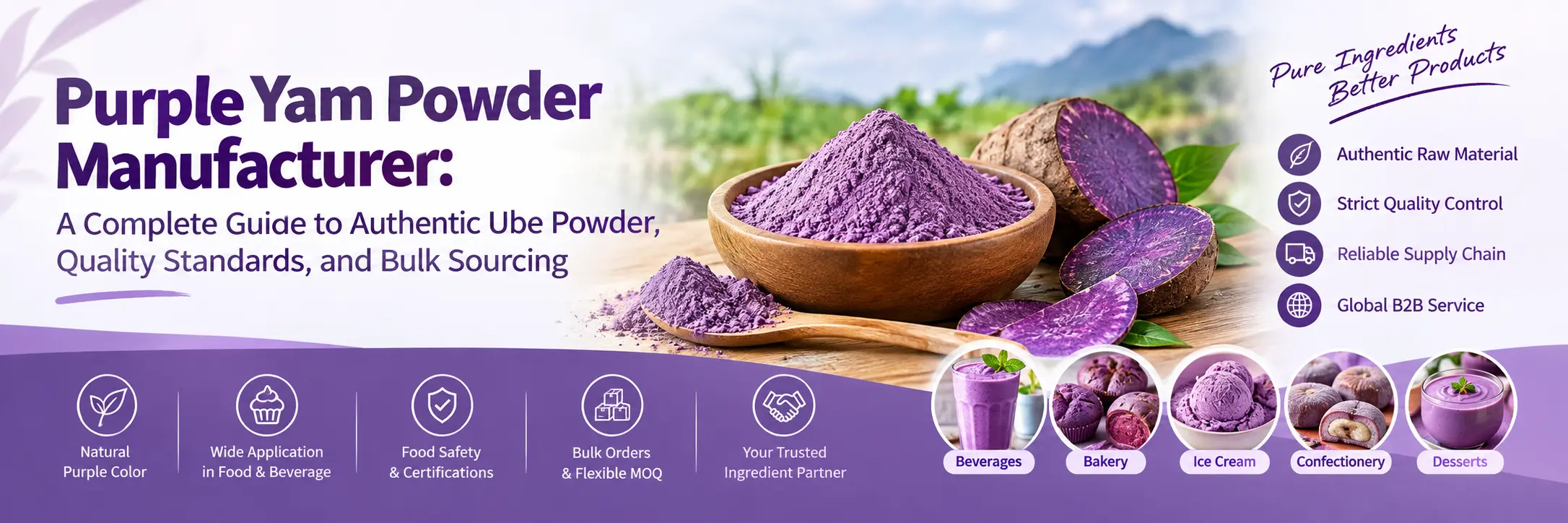
Looking for a reliable Purple Yam Powder Manufacturer? For food manufacturers, beverage brands, ingredient distributors, and private-label businesses, choosing the right supplier involves much more than comparing prices. Botanical authenticity, processing methods, color consistency, functional performance, food safety, and long-term supply reliability all influence the success of a finished product.
Purple yam powder, widely known as ube powder, is a versatile plant-based ingredient used in bakery products, beverages, ice cream, confectionery, and specialty food formulations. Its naturally purple appearance and distinctive yam flavor make it an attractive option for manufacturers developing visually appealing products with recognizable plant-based ingredients.
However, not all purple powders are made from the same raw material, and not every supplier offers the same level of quality control or technical support.
As an experienced botanical ingredient manufacturer, Changsha Vigorous-tech Co., Ltd. supports B2B customers seeking purple yam powder and other plant-based ingredients for commercial production. This guide explains how to evaluate purple yam powder, compare manufacturers, and select a supplier that meets your formulation and procurement requirements.
Purple yam powder is a powdered ingredient produced from the tuber of purple yam, commonly identified as Dioscorea alata. In many international food markets, particularly those influenced by Filipino cuisine, this ingredient is known as ube powder.
Depending on the raw material and processing method, purple yam powder can provide a naturally purple appearance, starch-based bulk, and a mild, characteristic yam flavor.
Unlike a highly purified extract, conventional whole-tuber powder generally retains a broader range of the original plant’s components, although the final composition depends on the production process.
Purple Yam Powder vs. Purple Sweet Potato Powder vs. Purple Potato Powder
These ingredients are frequently confused because they can share similar colors. For commercial food manufacturing, however, their botanical identities and functional characteristics should be clearly distinguished.
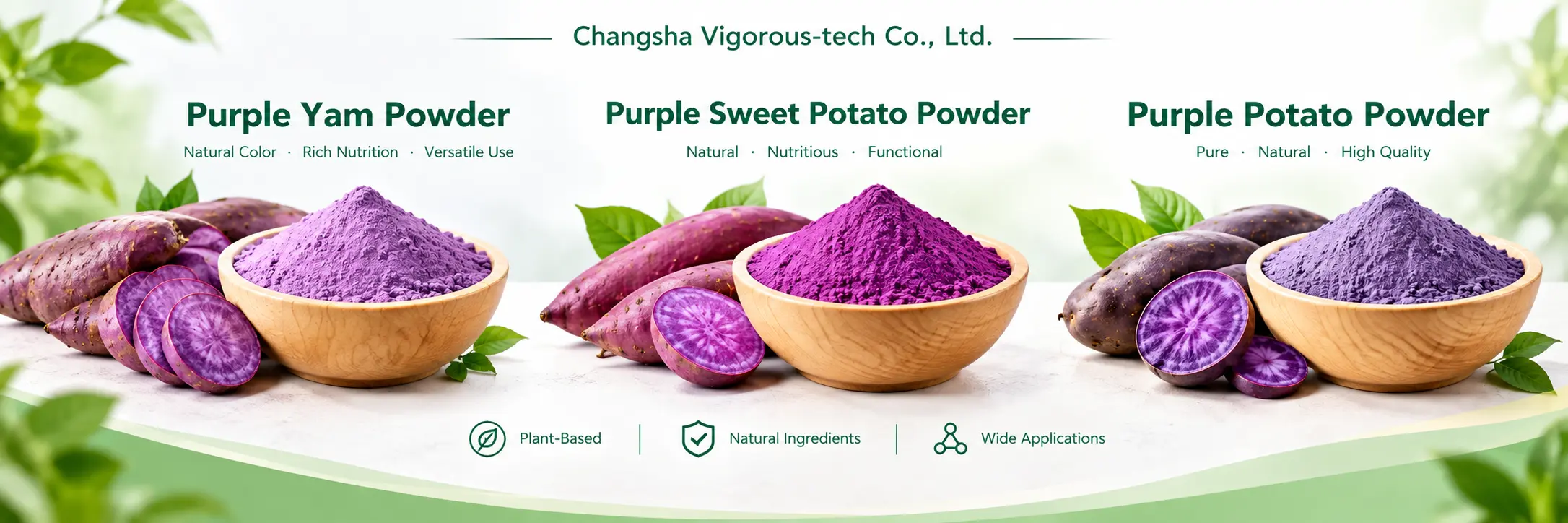
| Feature | Purple Yam Powder | Purple Sweet Potato Powder | Purple Potato Powder |
|---|---|---|---|
| Botanical source | Dioscorea alata | Ipomoea batatas | Solanum tuberosum |
| Common name | Ube powder | Purple sweet potato powder | Purple-fleshed potato powder |
| Typical flavor | Yam-like, mildly sweet | Sweet potato-like, earthy | Potato-like, savory or earthy |
| Main ingredient role | Flavor, color, and tuber solids | Tuber solids and natural color | Potato solids and natural color |
| Typical applications | Ube desserts, beverages, bakery | Bakery, noodles, beverages | Snacks, savory foods, specialty starch applications |
The exact color, flavor, starch behavior, and pigment composition vary by cultivar and processing conditions.
Why does botanical identity matter?
A manufacturer developing an ube latte, purple bakery filling, or signature dessert may specifically require authentic purple yam. Substituting purple sweet potato powder could change the product’s flavor, ingredient declaration, and consumer positioning.
For this reason, professional buyers should verify the botanical name and raw material source rather than relying on the commercial name or powder color alone.
A dependable manufacturer does more than supply a finished powder. It helps buyers establish repeatable specifications, assess product suitability, and reduce the risks associated with ingredient sourcing.
2.1 Raw Material Authenticity and Traceability
Raw material identity is the foundation of ingredient quality.
When evaluating a purple yam powder supplier, ask for:
Changsha Vigorous-tech Co., Ltd. can support discussions about raw material authenticity and provide available raw material or cultivation-related documentation for evaluation.
For businesses selling premium ube products, documentation supporting botanical identity can be particularly useful when qualifying suppliers or preparing internal quality files.
2.2 Processing Methods and Their Effect on Quality
The processing method influences the final powder’s color, flavor, moisture content, particle size, and performance during formulation.
A typical purple yam powder production process may include:
Not every manufacturer uses the same process. Some products are cooked before drying, while others follow different preparation methods.
For this reason, buyers should ask manufacturers to confirm their actual processing method rather than assuming all purple yam powders are produced identically.
2.3 Consistent Quality for Commercial Production
A powder that performs well in a laboratory sample must also perform consistently in commercial manufacturing.
Important quality factors include:
The appropriate acceptance limits depend on the product specification, intended application, and destination market.
A professional supplier should be able to explain its testing approach and provide a Certificate of Analysis (COA) for the relevant product or batch.
Choosing a purple yam powder manufacturer based on price alone can lead to formulation problems, inconsistent finished products, or unexpected quality costs.
The following criteria provide a more practical purchasing framework.
Color and Appearance
Purple yam powder can range from lighter purple to deeper violet, depending on the raw material and manufacturing conditions.
A darker color does not automatically indicate better quality. The appropriate color should match the target product and be assessed under consistent testing conditions.
For manufacturers developing colorful beverages, cakes, fillings, or ice cream, evaluate the powder in the actual application rather than judging it only in its dry form.
Flavor and Aroma
Authentic purple yam has a characteristic flavor that differs from purple sweet potato and taro.
In finished products, perceived flavor also depends on dosage, heating, sugar content, fat content, and other ingredients.
If flavor identity is important to your brand, conduct a sensory evaluation using a representative sample before approving a bulk order.
Particle Size and Dispersion
Particle size affects mixing, texture, mouthfeel, and processing behavior.
A finer powder may be suitable for certain beverage mixes or smooth dessert formulations, while other applications may tolerate a coarser particle size.
It is also important to distinguish between solubility and dispersibility.
Whole-tuber purple yam powder generally contains insoluble plant material and starch. It should not automatically be expected to dissolve completely in cold water like a highly soluble extract or purified ingredient.
For instant beverages, assess wetting, lump formation, sedimentation, viscosity, and the need for homogenization or other processing adjustments.
Moisture and Storage Stability
Excess moisture can contribute to caking and may affect storage stability.
Buyers should review moisture specifications, packaging performance, recommended storage conditions, and shelf-life information.
The finished product should be stored in a cool, dry environment and protected from moisture and unsuitable temperature conditions, in accordance with the supplier’s instructions.
Documentation and Food Safety
For B2B procurement, quality documents are essential for supplier approval and ongoing production.
Depending on the application and market, request:
Changsha Vigorous-tech Co., Ltd. has food safety and quality credentials that include FSSC 22000, ISO 22000, and GMP-related credentials, alongside relevant Kosher, Halal, and organic certifications within its product portfolio. The exact scope and validity should be confirmed for the specific facility and product before procurement.

Purple yam powder offers opportunities across several food and beverage categories. Its suitability depends on the formulation, processing conditions, and desired flavor and color.
4.1 Bakery and Pastry Products
Purple yam powder can be incorporated into:
For bakery manufacturers, it can contribute color, flavor, and tuber solids.
However, because it contains starch and other plant components, adding purple yam powder may change dough hydration, texture, density, and baking behavior. Recipe adjustments and pilot trials are recommended before commercial production.
4.2 Beverages and Instant Drink Mixes
Potential applications include:
For these applications, manufacturers should evaluate dispersion, sedimentation, flavor balance, and stability under the intended processing and storage conditions.
If a completely clear or fully soluble beverage is required, conventional whole-tuber powder may not be the appropriate ingredient. A specifically processed or extracted ingredient may need to be evaluated instead.
4.3 Ice Cream and Frozen Desserts
Purple yam powder can be used in ice cream, gelato, frozen yogurt, and other frozen dessert formulations.
Its plant-based solids can influence body and texture, while its color and flavor can contribute to product identity.
For commercial development, test the powder in the complete formulation. Fat content, sugar concentration, stabilizers, freezing conditions, and storage can all affect the finished product’s sensory characteristics.
4.4 Confectionery and Dessert Fillings
Possible applications include:
Manufacturers should evaluate the ingredient’s behavior under the intended heating, cooling, and storage conditions.
4.5 Plant-Based and Specialty Food Products
Purple yam powder may also be considered for selected plant-based mixes, breakfast products, meal preparations, and specialty food concepts.
Its suitability depends on the product’s nutritional targets, sensory requirements, processing conditions, and labeling strategy.
Although purple yam contains naturally occurring plant compounds, the nutritional composition of a commercial powder must be established from appropriate analytical data. Avoid assuming that all powders provide identical levels of anthocyanins, dietary fiber, minerals, or other constituents.
Before placing a bulk order, define the specification around your application rather than selecting a product based on a generic description.
The following table lists parameters that B2B buyers should discuss with their supplier.
| Specification | Why It Matters |
|---|---|
| Botanical name | Confirms the intended raw material |
| Plant part | Clarifies which part of the plant is used |
| Ingredient composition | Establishes whether the product is whole-tuber powder or a formulated blend |
| Appearance | Defines acceptable color and physical characteristics |
| Particle size | Supports consistent mixing and texture |
| Moisture content | Helps assess storage and handling requirements |
| Microbiological limits | Supports food safety and product qualification |
| Heavy metals | Supports destination-market compliance |
| Pesticide residues | Relevant to raw material and market requirements |
| Packaging | Protects product quality during transportation and storage |
| Shelf life | Supports inventory planning |
| Documentation | Helps meet internal quality and regulatory requirements |
Important: Do not treat a supplier’s general product page as a substitute for an approved specification. Confirm the actual numerical limits, analytical methods, and batch results with the manufacturer.
For food applications, the buyer should also establish whether the ingredient contains only purple yam or includes carriers, added colors, flavors, or other processing ingredients.
When comparing manufacturers, procurement teams should evaluate the complete supply relationship rather than focusing exclusively on the quoted price per kilogram.
Manufacturer vs. Trading Company
A direct manufacturer may offer closer access to production information, technical personnel, and quality records. A trading company may provide useful sourcing flexibility or access to multiple origins.
Neither business model guarantees quality by itself. Buyers should verify the supplier’s actual role and capabilities.
Useful questions include:
Sample Evaluation Before Bulk Purchasing
A representative sample allows the buyer to test the ingredient under realistic conditions.
A practical qualification process includes:
For larger orders, buyers should also consider whether the supplier can maintain the agreed specification across subsequent batches.
Supply Flexibility and Communication
For manufacturers managing several product lines, a responsive supplier can help simplify procurement.
Changsha Vigorous-tech Co., Ltd. has more than 20 years of experience in plant-based ingredients and offers a broader botanical ingredient portfolio, allowing B2B buyers to discuss related sourcing requirements with one supplier.
Available support includes flexible minimum order quantities subject to product and order requirements, sample evaluation, customized packaging discussions, and assistance with ingredient documentation.
Standard in-stock items may be dispatched within approximately 1–3 days, while customized solutions may require around 5–15 days. Actual lead times depend on inventory, specifications, order quantity, testing, and packaging requirements and should be confirmed when requesting a quotation.
For international buyers, selecting a supplier is a long-term business decision. Reliable communication, traceable raw materials, appropriate documentation, and dependable order fulfillment all contribute to a sustainable purchasing relationship.
Changsha Vigorous-tech Co., Ltd. works with overseas B2B customers seeking botanical powders, plant extracts, natural ingredient solutions, and related food ingredients.
More Than 20 Years of Industry Experience
With more than two decades of experience in botanical ingredients, the company understands that different customers require different specifications, documentation, packaging, and supply arrangements.
Our objective is to help customers identify suitable ingredients for their products and establish workable sourcing plans.
Raw Material Identity and Traceability Support
For buyers requiring authentic purple yam, botanical identity should be clarified before the order is finalized.
We can discuss available raw material information and supporting cultivation-related documentation to help customers assess ingredient authenticity.
Quality and Certification Support
Our quality-related credentials include FSSC 22000, ISO 22000, and GMP-related credentials, with additional certifications available within the relevant product portfolio.
Product-specific certificates, analytical reports, and other supporting documents should be confirmed according to the requested ingredient and destination market.
Flexible Order and Packaging Arrangements
We understand that different B2B customers operate at different stages of development.
A new product developer may need a small evaluation quantity, while an established food manufacturer may require repeat bulk orders.
We support discussions around flexible MOQs, samples, customized packaging, and private-label requirements, subject to the product and project.
A Broader Botanical Ingredient Portfolio
In addition to purple yam powder, our product range includes purple sweet potato powder, butterfly pea flower powder, pumpkin powder, beetroot powder, mushroom extracts, and natural sweetener ingredients such as stevia and monk fruit products.
This broader portfolio can help buyers consolidate selected ingredient sourcing requirements and explore complementary ingredients for future formulations.
Responsive Communication and Long-Term Cooperation
International ingredient procurement involves more than product availability. It also requires clear specifications, timely document exchange, coordinated shipping, and effective communication when issues arise.
Our team aims to provide responsive support throughout sample evaluation, order confirmation, documentation, and repeat purchasing.
Q1. What is the botanical name of purple yam powder?
Purple yam, commonly known as ube, is generally identified as Dioscorea alata. Buyers should confirm the botanical identity on the supplier’s specification and supporting documentation.
Q2. Is purple yam powder the same as ube powder?
In most food ingredient contexts, purple yam powder and ube powder refer to powder made from purple yam. However, commercial naming can vary, so the botanical source and ingredient composition should always be checked.
Q3. Is purple yam powder the same as purple sweet potato powder?
No. Purple yam is generally Dioscorea alata, while purple sweet potato is Ipomoea batatas. They have different botanical identities and may differ in flavor, composition, color, and formulation performance.
Q4. Can purple yam powder be used as a natural food color?
Purple yam powder can contribute a natural purple appearance to foods. However, whole-tuber powder is not equivalent to a standardized food-coloring extract. Its color intensity and performance depend on the raw material, processing, dosage, and finished formulation.
Q5. Is purple yam powder water-soluble?
Conventional whole-tuber purple yam powder should not automatically be considered fully water-soluble. Its starch and insoluble components can affect dispersion, sedimentation, and texture. Buyers developing instant drinks should conduct application trials.
Q6. What products can be made with purple yam powder?
Common applications include bakery products, ube beverages, ice cream, frozen desserts, confectionery, fillings, and specialty food mixes.
Q7. How can I verify the quality of bulk purple yam powder?
Review the botanical identity, product specification, COA, applicable microbiological and contaminant testing, particle size, moisture content, and packaging information. Conduct sample testing before approving commercial production.
Q8. Can I request a sample before placing a bulk order?
Yes. Sample availability and shipping arrangements can be discussed with Changsha Vigorous-tech Co., Ltd. Provide your intended application and required specifications to help identify a suitable sample.
Q9. What is the minimum order quantity for purple yam powder?
The MOQ depends on the product specification, packaging, inventory, and order requirements. Contact our team with your estimated quantity so we can confirm the applicable MOQ.
Q10. Can you provide a COA and third-party testing reports?
Relevant product documentation can be discussed during supplier qualification. The availability and scope of the COA, third-party testing reports, and other certificates depend on the specific product and batch.
Q11. Can you support customized packaging or private labeling?
Customized packaging and private-label arrangements can be discussed according to the product, order quantity, packaging materials, and labeling requirements.
Q12. How long does delivery take?
In-stock products may be dispatched within approximately 1–3 days, while customized solutions may require around 5–15 days. These are indicative lead times, not guaranteed delivery dates. Confirm the actual schedule with our team.
Q13. How should purple yam powder be stored?
Follow the supplier’s product-specific storage instructions. In general, keep the powder sealed in a cool, dry place, protect it from moisture and excessive heat, and avoid contamination during handling.
Q14. Can purple yam powder be used in vegan or plant-based products?
It may be suitable for vegan or plant-based formulations, provided the ingredient composition and processing aids meet the buyer’s requirements. Verify the declaration and relevant manufacturing information before making a finished-product claim.
Q15. How do I request a quotation from a purple yam powder manufacturer?
Send the required product name, intended application, estimated quantity, destination country, preferred packaging, and any mandatory specifications or certificates. This information helps the supplier provide a more relevant quotation and identify potential technical requirements.
Selecting the right purple yam powder manufacturer begins with a clear understanding of your product requirements.
Whether you are developing ube beverages, bakery ingredients, frozen desserts, confectionery, or specialty food formulations, we can discuss suitable ingredient specifications and sourcing arrangements for your project.
Changsha Vigorous-tech Co., Ltd. welcomes inquiries from food manufacturers, ingredient distributors, importers, and private-label businesses seeking long-term B2B cooperation.
When contacting us, please include:
Our team will review your requirements and help determine the appropriate next steps.
Contact Changsha Vigorous-tech Co., Ltd.
Website: https://www.vigorous-tech.com/
WhatsApp & WeChat: +86 13142031766
E-Mail: info@vigorous-tech.com
We focus on B2B ingredient supply and cooperation with commercial buyers. Contact us to discuss samples, specifications, pricing, and bulk purchasing requirements.
Nr. A6 Lugu International Industrial Park, 229# West Tongzipo Road, High-Tech Development Zone, Changsha 410205, Hunan, VR China
13142031766



We work with business customers and manufacturers. Individual consumer orders are not accepted.

 DE_AT
 EN
 DE
 ZH
 DE_CH
 ES
 FR
 FR_CA
 AF
 JA
 EN_AU
 EN_GB
 EN_CA
 ES_CL
 RU