

Authentic Botanical Source
Professional Manufacturing
Quality Documentation
Flexible MOQ
Customization Available
One-Stop Botanical Ingredient Supply
Factory Visit Welcome

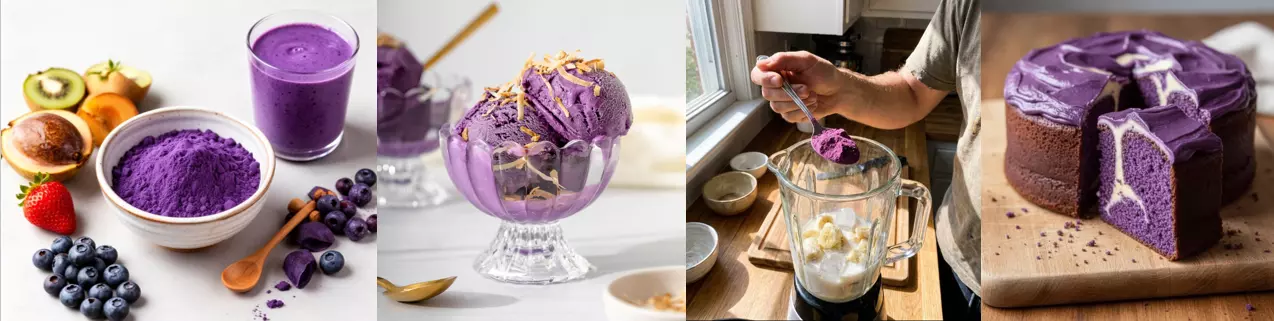
Purple yam powder is becoming an increasingly interesting ingredient for food, beverage, and functional food manufacturers looking for naturally purple, plant-based, and versatile ingredients.
Made from purple yam, scientifically known as Dioscorea alata L., purple yam powder is naturally rich in starch and contains various phytochemicals, including anthocyanins, phenolic compounds, and flavonoids. Research has also investigated its resistant starch, antioxidant properties, and potential applications in functional foods.
But what are the actual purple yam powder benefits, and how much of the health-related information can be supported by scientific evidence?
This article explains what purple yam powder is, its nutritional characteristics, potential benefits, applications, and what manufacturers should consider when sourcing high-quality purple yam powder.
Purple yam powder is a finely milled powder made from the tubers of Dioscorea alata L., commonly known as purple yam, greater yam, or water yam.
It is particularly recognized for its naturally purple color, which comes primarily from anthocyanin pigments.
Purple yam is different from purple sweet potato. Although both are purple-colored root crops, they belong to different botanical species:
| Ingredient | Botanical Name | Main Characteristics |
|---|---|---|
| Purple Yam | Dioscorea alata L. | Naturally purple, starchy, mild yam flavor |
| Purple Sweet Potato | Ipomoea batatas | Purple flesh, sweet potato flavor |
| Taro | Colocasia esculenta | Creamy texture, typically white or light purple |
| Ube | Commonly refers to Dioscorea alata | Popular in Filipino desserts and beverages |
The terms purple yam and ube are frequently used interchangeably in food marketing, particularly in the Philippines and other Southeast Asian markets. However, manufacturers should verify the botanical identity of the raw material rather than relying solely on the commercial name.
1. Naturally Contains Anthocyanins
One of the most interesting characteristics of purple yam is its naturally occurring anthocyanins.
Anthocyanins are plant pigments belonging to the flavonoid family and are responsible for many red, blue, and purple colors found in fruits and vegetables.
Scientific research has identified several anthocyanin compounds in Dioscorea alata, including derivatives associated with cyanidin and peonidin.
This is particularly relevant for manufacturers because consumers increasingly associate naturally colored foods with plant-based and clean-label formulations.
For product developers, purple yam powder can provide two functions at once:
However, anthocyanin concentration can vary significantly according to variety, cultivation conditions, maturity, processing, and storage. Research on Thai purple yam varieties, for example, found substantial differences in anthocyanin levels between accessions.
2. Provides Antioxidant-Related Phytochemicals
Purple yam contains several groups of phytochemicals, including anthocyanins, phenolic compounds, and flavonoids.
Research comparing purple and white Dioscorea alata tubers found that purple tubers had higher total phenolic and flavonoid contents and higher measured antioxidant activity.
Other research has specifically investigated anthocyanins isolated from purple yam and their antioxidant activity using laboratory assays.
What does this mean for consumers?
It means purple yam is scientifically interesting as a source of naturally occurring antioxidant-related compounds.
However, an important distinction should be made:
Antioxidant activity measured in a laboratory does not automatically mean that consuming purple yam powder will produce the same effect in humans.
More human clinical research is needed before making strong disease-prevention or therapeutic claims.
For responsible food marketing, phrases such as “contains naturally occurring anthocyanins” are more scientifically appropriate than claiming that purple yam powder “prevents disease” or “treats inflammation.”
3. May Support a Fiber-Rich, Starch-Based Diet
Purple yam is primarily a starchy root crop, but it also contains dietary fiber.
Research examining different Dioscorea alata varieties reported dietary fiber levels ranging from approximately 4.1% to 11.0%, demonstrating considerable variation among varieties.
For food manufacturers, this makes purple yam particularly interesting for formulations targeting:
The actual nutritional composition of commercial purple yam powder depends on the yam variety and processing method, so manufacturers should always request a current specification and Certificate of Analysis (COA).
4. Contains Starch and May Provide Resistant Starch
Another interesting area of purple yam research is resistant starch.
Unlike rapidly digestible starch, resistant starch is not completely digested in the small intestine and can reach the large intestine, where it may be fermented by gut microorganisms.
Purple yam has relatively high amylose content, which has attracted research interest in its potential as a source of resistant starch.
In one study, incorporating purple yam flour into wheat bread increased the measured resistant starch content of the bread. The researchers reported an increase from 34.9% in the wheat-flour bread to 41.3% in bread containing 30% purple yam flour.
This does not mean that all purple yam powder products are automatically “high in resistant starch.”
Processing conditions, particle size, cooking, cooling, formulation, and the specific yam variety can all influence starch digestibility.
Nevertheless, resistant starch remains an interesting research direction for developers working on digestive-health and functional-food concepts.
5. Potential Gut Health Applications
The relationship between purple yam and gut health is another emerging area of research.
A 2025 study investigating purple yam jam found nondigestible carbohydrate fractions, including resistant starch, and explored its potential prebiotic effects using Lacticaseibacillus casei in an in vitro model.
This is promising from a food-development perspective, but it is important to distinguish between:
“Potential prebiotic activity observed in laboratory research”
and
“Clinically proven to improve human gut health.”
The latter requires human clinical evidence.
For B2B manufacturers, this distinction is particularly important when developing marketing claims for different countries.
6. Naturally Provides Purple Color for Food Formulations
Perhaps one of the biggest commercial advantages of purple yam powder is its visual appeal.
Instead of using an isolated synthetic-looking color, manufacturers can use purple yam as a recognizable plant-based ingredient.
Purple yam powder can be incorporated into:
Its natural purple color can help brands create products that are visually distinctive while maintaining a recognizable food ingredient story.
7. Fits the Growing Demand for Plant-Based and Naturally Derived Ingredients
Purple yam sits at the intersection of several important food-industry trends:
Natural color + plant-based ingredients + recognizable foods + functional nutrition + Asian-inspired flavors.
The ingredient is particularly attractive for manufacturers developing products with an ube or purple yam flavor profile.
Instead of purchasing separate ingredients for color and flavor, a purple yam-based formulation can potentially deliver both the visual identity and characteristic yam profile, depending on the grade and processing method.
This makes purple yam powder particularly interesting for:
One of the most common questions from product developers is:
Is purple yam powder better than purple sweet potato powder?
There is no universal winner. They are different ingredients with different characteristics.
| Feature | Purple Yam Powder | Purple Sweet Potato Powder |
|---|---|---|
| Botanical source | Dioscorea alata | Ipomoea batatas |
| Flavor | Yam-like, mildly sweet | Sweet potato-like |
| Color | Purple to violet | Purple to reddish-purple |
| Starch | High | High |
| Anthocyanins | Naturally present | Naturally present |
| Ube applications | Excellent | Different flavor profile |
| Bakery | Excellent | Excellent |
| Beverage | Good | Good |
| Dessert | Excellent | Excellent |
| Asian-inspired products | Particularly suitable | Suitable |
If your formulation specifically requires an authentic ube/purple yam identity, Dioscorea alata is generally the more appropriate raw material.
This is an important SEO question because “ube” is one of the most commercially popular search terms associated with purple yam.
Ube generally refers to purple yam, particularly Dioscorea alata, and is strongly associated with Filipino cuisine.
It is widely used in products such as:
However, not every purple-colored yam or sweet potato product is necessarily authentic ube.
For B2B buyers, botanical identification is therefore important.
If authenticity is important for your product, ask your supplier for documentation showing the botanical source and raw-material origin.
Not all purple yam powders have the same quality.
Before purchasing, B2B buyers should evaluate at least the following factors.
1. Botanical Identification
Confirm that the raw material is actually:
Dioscorea alata L.
rather than purple sweet potato or another purple-colored tuber.
2. Raw Material Traceability
Ask about:
For products marketed as authentic ube or purple yam, traceability is particularly valuable.
3. Color
Color can provide useful information about the raw material and processing, although color alone cannot determine quality.
4. Moisture
Moisture affects:
5. Microbiological Quality
Commercial buyers should request microbiological testing appropriate for the intended application.
6. Heavy Metals and Pesticide Residues
For international food ingredient sourcing, buyers may request:
Additional testing may be required depending on the destination market and product application.
A typical production process may include:
Raw Purple Yam → Sorting → Washing → Peeling → Cutting → Drying → Milling → Sieving → Quality Control → Packaging
The drying method can significantly influence the final characteristics of the powder.
Research has shown that processing and drying conditions can affect phenolic compounds and antioxidant-related properties in yam products.
For industrial applications, manufacturers therefore need to balance:
Purple yam powder is highly versatile and can be used across multiple food categories.
|
Beverage Use it in:
|
Bakery Potential applications include:
|
Dessert Purple yam powder is particularly suitable for:
|
Confectionery It can also be explored in:
|
Functional Food Because purple yam naturally contains starch and phytochemicals, it can be considered for:
|
The appropriate application depends on the powder’s specifications, processing method, dosage, and local regulatory requirements.

Purple yam works particularly well in formulations where color, flavor, and nutrition need to work together.
Some potential ingredient combinations include:
Purple Yam + Coconut Milk Powder
A natural combination for:
The creamy coconut profile can complement the characteristic flavor of purple yam.
Purple Yam + Butterfly Pea
This combination can create visually interesting purple and blue formulations and can be explored in beverage applications.
Purple Yam + Monk Fruit Extract
For brands developing reduced-sugar concepts, monk fruit can be considered as a sweetening component.
Purple Yam + Green Tea Extract
A combination worth exploring for functional beverage concepts where botanical ingredients and natural color are important.
Purple Yam + Lion’s Mane Extract
For functional-food developers, purple yam can provide the food base while mushroom extracts can be incorporated into a more specialized formulation.
The term “superfood” is primarily a marketing term rather than a standardized scientific or regulatory category.
Purple yam does have several characteristics that make it nutritionally interesting:
Scientific literature supports continued research into Dioscorea alata as a functional food ingredient. A recent review published in 2026 summarized research investigating antioxidant, anti-inflammatory, metabolic, cardiovascular, and gut-microbiome-related activities of Dioscorea alata, while also emphasizing the need for further phytochemical and clinical research.
Therefore, a more evidence-based description would be:
Purple yam is a nutrient-rich root crop with naturally occurring anthocyanins and other phytochemicals that has potential for functional food applications.
That is more scientifically responsible than simply calling it a “miracle superfood.”
1.Is purple yam powder healthy?
Purple yam powder can be part of a balanced diet and contains starch, dietary fiber, anthocyanins, phenolic compounds, and other naturally occurring plant compounds. However, its nutritional composition varies by cultivar and processing method.
2.What are the main benefits of purple yam powder?
The most notable characteristics include its naturally occurring anthocyanins and phytochemicals, starch content, dietary fiber, potential resistant-starch properties, and versatility as a naturally purple food ingredient.
3.Is purple yam the same as ube?
Ube commonly refers to purple yam, particularly Dioscorea alata. However, terminology can vary by market, so B2B buyers should verify the botanical name.
4.Is purple yam better than purple sweet potato?
Neither is universally better. Purple yam and purple sweet potato are different crops with different flavors, textures, nutritional profiles, and processing characteristics.
5.Does purple yam contain anthocyanins?
Yes. Research has identified multiple anthocyanins in Dioscorea alata, including cyanidin- and peonidin-related compounds.
6.Can purple yam powder be used in beverages?
Yes. It can be used in smoothies, shakes, instant drink mixes, ube beverages, and other formulations, subject to the powder’s specifications and processing requirements.
7.Can purple yam powder be used in bakery products?
Yes. Purple yam flour/powder has been studied in bread formulations and can be used in various bakery applications.
8.Does purple yam contain resistant starch?
Purple yam contains starch with relatively high amylose characteristics, and research has investigated its resistant starch potential. Actual resistant starch levels depend on variety and processing.
9.Is purple yam powder naturally purple?
Yes. The purple color is associated primarily with anthocyanin pigments naturally present in purple yam.
For international B2B buyers, ingredient quality starts with raw-material authenticity and traceability.
At Changsha Vigorous-Tech, we supply purple yam powder for food and ingredient manufacturers looking for a reliable bulk ingredient partner.
Authentic Botanical Source
We can provide species/cultivation documentation to help verify that the raw material is genuine Dioscorea alata rather than a substitute purple-colored crop.
Professional Manufacturing
With more than 20 years of experience in botanical ingredients and plant-based powders, we understand the quality requirements of international B2B buyers.
Quality Documentation
COA and relevant testing documents can be provided according to product requirements.
Flexible MOQ
We support flexible order quantities for product development, sampling, and commercial production.
Customization Available
Particle size, packaging, and other specifications can be discussed according to the customer’s application.
One-Stop Botanical Ingredient Supply
Besides purple yam powder, we can also supply complementary ingredients such as purple sweet potato powder, butterfly pea extract, monk fruit extract, coconut milk powder, mushroom extracts, and other botanical ingredients.
Factory Visit Welcome
Qualified B2B customers are welcome to arrange a factory visit and discuss sourcing, formulation, and customized ingredient solutions with our team.
Purple yam powder is more than just a colorful food ingredient.
Its combination of natural purple color, starch, dietary fiber, anthocyanins, phytochemicals, distinctive flavor, and broad food applications makes it an increasingly interesting ingredient for modern food formulation.
Scientific research supports its potential as a functional food ingredient, particularly in areas involving anthocyanins, antioxidant-related activity, resistant starch, and gut-health research. At the same time, many health-related findings remain preliminary or are based on laboratory and animal studies, so responsible manufacturers should avoid exaggerated health claims.
For brands developing ube products, naturally colored foods, plant-based beverages, functional foods, bakery products, and better-for-you desserts, purple yam powder offers an attractive combination of color + flavor + ingredient functionality.
Looking for authentic Dioscorea alata Purple Yam Powder for your next product?
Contact our team to request the specification, COA, sample, raw-material traceability information, and customized packaging options.
Nr. A6 Lugu International Industrial Park, 229# West Tongzipo Road, High-Tech Development Zone, Changsha 410205, Hunan, VR China
13142031766




 DE_AT
DE_AT  EN
EN  DE
DE  ZH
ZH  DE_CH
DE_CH  ES
ES  FR
FR  FR_CA
FR_CA  AF
AF  JA
JA  EN_AU
EN_AU  EN_GB
EN_GB  EN_CA
EN_CA  ES_CL
ES_CL  RU
RU