
Can't find what you need? → Request a Custom Ingredient
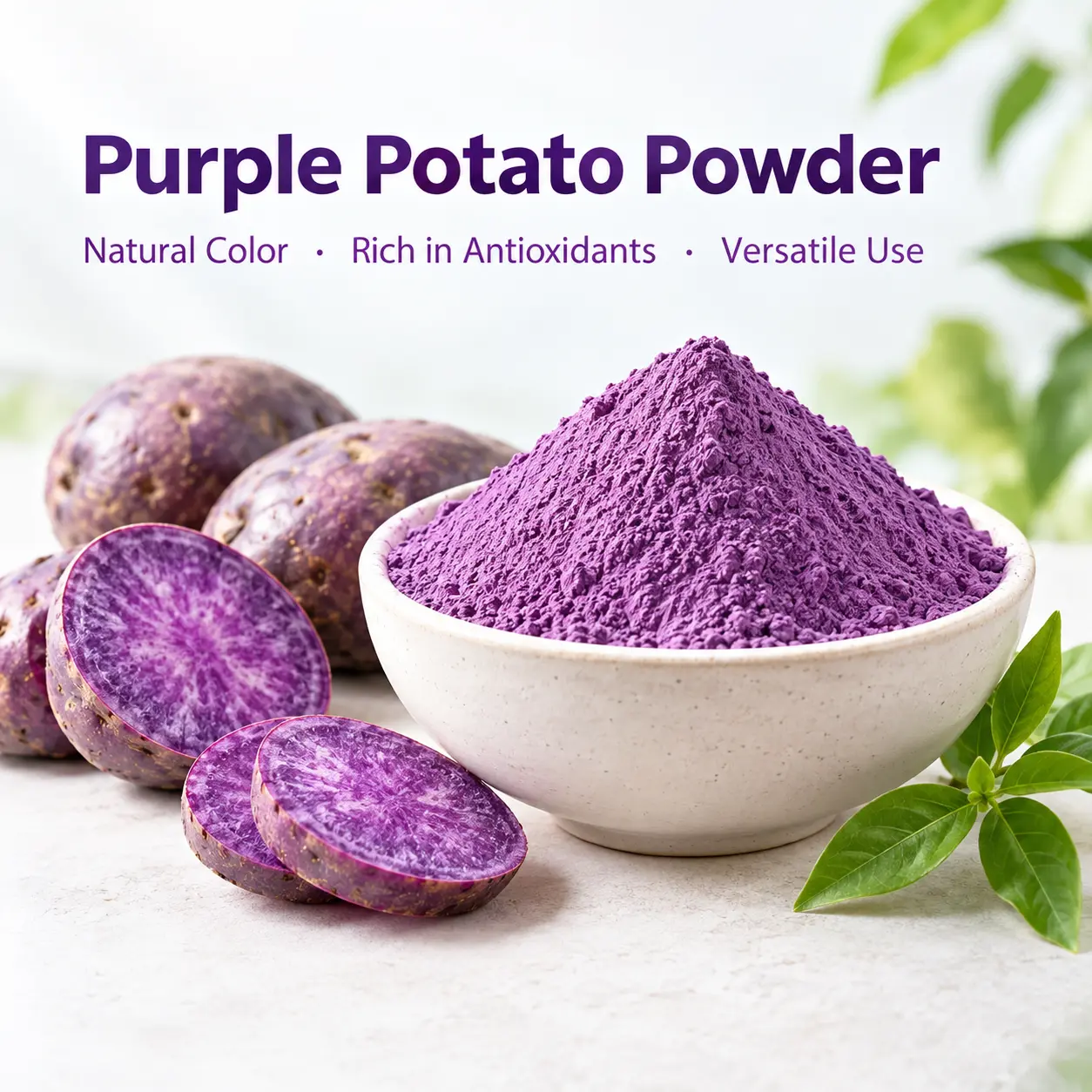
Our product: Purple Sweet Potato Powder
Latin name: *Ipomoea batatas* (L.) Lam
It is 100% natural dehydrated purple sweet potato tuber powder, food grade, rich in anthocyanin.
MOQ is 25kg. Package: 25kg/drum.
We support sample supply (20g sample available, freight collect). COA, MSDS, Halal, Kosher documents can be offered upon request. It can be applied in bakery, drinks, yogurt and snack products.

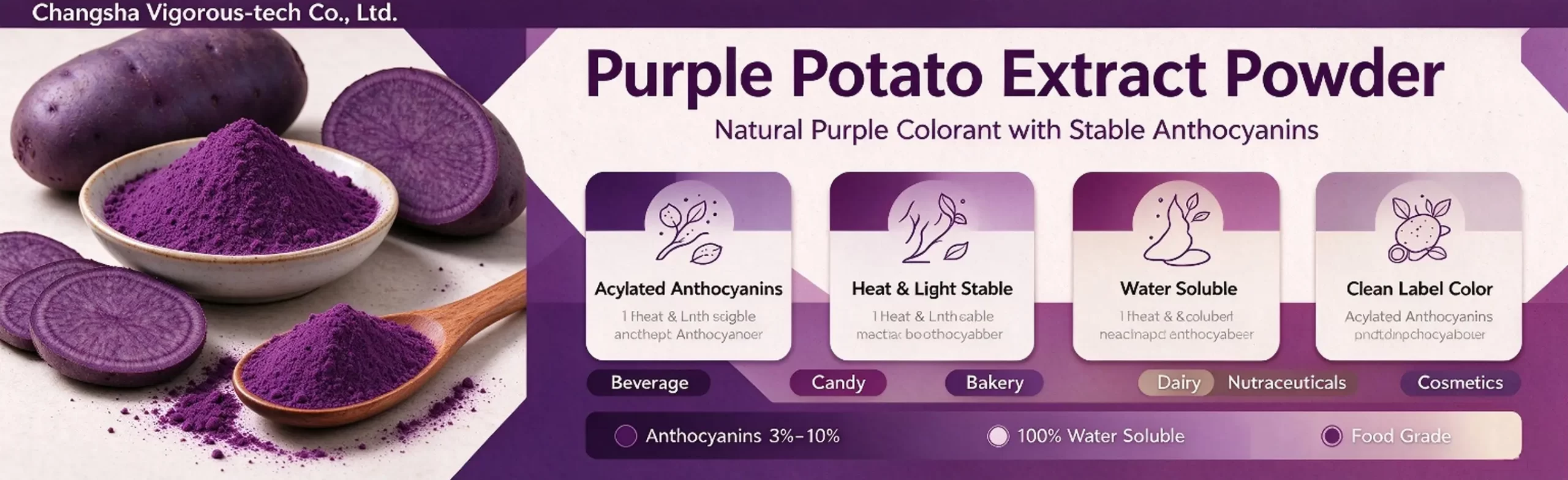
Purple potato extract is a plant-derived ingredient obtained from purple-fleshed potato tubers, typically belonging to Solanum tuberosum. Unlike conventional white or yellow potatoes, purple potatoes contain naturally occurring pigments that give their flesh distinctive violet, purple, or blue-purple hues.
One of the most important groups of these pigments is anthocyanins, water-soluble compounds belonging to the flavonoid family. Depending on the potato variety and extraction process, purple potato extract may also contain other phenolic compounds.
Anthocyanins are of particular interest to food scientists and ingredient manufacturers because they contribute to natural coloration and exhibit antioxidant activity in laboratory studies. Research on colored-flesh potatoes has identified petunidin derivatives among the major anthocyanin compounds in certain purple potato varieties. However, the exact composition varies by cultivar and processing conditions. Research reference
For manufacturers, the value of purple potato extract is not simply its purple appearance. Its potential lies in combining plant-derived pigments with an ingredient format that can be evaluated for specific formulation requirements.
Purple Potato Extract vs. Purple Potato Powder
These two terms are not necessarily interchangeable.
For B2B buyers, this distinction matters. A food manufacturer seeking potato solids or a whole-food ingredient has different requirements from a beverage developer seeking a concentrated natural purple pigment.
Before purchasing, confirm the botanical source, extraction method, anthocyanin specification, carrier ingredients, solubility, and intended application.
2.1 Natural pigmentation and formulation potential
Anthocyanins are responsible for much of the red, purple, and blue coloration found in various fruits, vegetables, and flowers.
Their color is influenced by several factors, including molecular structure, pH, temperature, and the surrounding food matrix. This makes anthocyanin-rich ingredients interesting for natural-color development, but it also means that selecting a pigment requires more than comparing the color of two dry powders.
For example, a purple potato extract may produce different shades under acidic and less acidic conditions. The final appearance also depends on the concentration used, the presence of other ingredients, and the processing conditions.
For food manufacturers, practical evaluation should include:
A laboratory sample test is recommended before scaling up production.
2.2 Antioxidant properties: Understanding the evidence
Anthocyanins and other phenolic compounds have demonstrated antioxidant activity in various laboratory assays. Research on purple-fleshed potatoes has also investigated the relationship between pigment concentration, processing, storage conditions, and antioxidant activity.
However, an important distinction must be made between antioxidant activity measured in a laboratory and proven health benefits in humans. Results from chemical assays do not establish that consuming a particular commercial extract will prevent disease or deliver a specific physiological effect.
For ingredient developers, the most useful approach is to evaluate the extract’s measured composition and intended function rather than relying on generalized health claims.
If a product is marketed as an anthocyanin-rich ingredient, buyers should request an appropriate analytical report confirming the relevant marker compounds or total anthocyanin content.
2.3 Anthocyanin stability: A critical consideration for manufacturers
Natural purple pigments can be sensitive to their processing environment.
Research on colored-flesh potato extracts has shown that light exposure and room-temperature storage can contribute to substantial anthocyanin losses under certain experimental conditions. Other studies have demonstrated that pH and heat treatment can change anthocyanin concentration and visible color. Research on purple potato extract stability
This has direct implications for commercial product development.
For beverage manufacturers: Evaluate the pigment in the actual beverage, not just in water. Acidity, minerals, sweeteners, preservatives, and other ingredients can affect color performance.
For confectionery manufacturers: Test the ingredient under the actual cooking, molding, and cooling conditions used in production.
For powdered premixes: Assess moisture exposure, storage temperature, packaging barrier properties, and color retention over the intended shelf life.
For supplement manufacturers: Check compatibility with the dosage form, processing temperature, excipients, and applicable market regulations.
A purple color that looks attractive in a sample bottle may not remain identical after processing. Pilot-scale testing is therefore an essential step in ingredient selection.
The suitability of purple potato extract depends on its composition, purity, solubility, and technical specifications. Potential application areas include the following.
3.1 Functional beverages and powdered drink mixes
Purple-colored beverages and plant-based drink mixes can use anthocyanin-containing ingredients to support a distinctive natural-color concept.
Potential development projects include powdered beverage blends, botanical drinks, fruit-flavored formulations, and specialty drink premixes.
Key purchasing considerations include water compatibility, color intensity, sediment formation, pH stability, and the effect of heat treatment on the finished product.
Not every purple potato extract is suitable for every beverage. A manufacturer should confirm the grade and test it in the intended formulation.
3.2 Confectionery and gummies
Color is an important element of product identity in gummies, jellies, candies, and other confectionery products.
Purple potato extract may be considered for formulations where a plant-derived purple hue is desired. However, high-temperature processing, acidity, and prolonged storage may affect the final shade.
Before commercial adoption, manufacturers should assess color retention, taste impact, texture compatibility, and batch-to-batch consistency.
3.3 Bakery products and dessert mixes
Purple-colored bakery products and desserts offer opportunities for ingredient developers seeking visually distinctive products.
Depending on the extract specification, possible areas for evaluation include cake mixes, dessert powders, fillings, and specialty bakery formulations.
The primary technical challenge is maintaining the intended color through baking or other heat-intensive processing. Testing the extract in the actual recipe is more informative than relying on the appearance of the raw ingredient.
3.4 Nutritional powders and dietary supplement formulations
Anthocyanin-containing plant extracts may be considered for nutritional powder blends and selected supplement formulations.
For these applications, buyers should prioritize compositional consistency, appropriate analytical testing, contaminant controls, and documentation supporting the intended use.
Importantly, the suitability of a purple potato extract for food coloring does not automatically establish its suitability for a dietary supplement. The regulatory status, permitted claims, and quality requirements must be assessed for the target market and product category.
3.5 Natural color development and product differentiation
For product developers, purple potato extract can be evaluated as part of a broader natural-color strategy.
Its performance should be compared with other potential sources of purple pigmentation, including purple sweet potato anthocyanins and other permitted plant-derived colorants.
The best choice depends on the target shade, regulatory requirements, processing conditions, ingredient cost, and the level of standardization required.
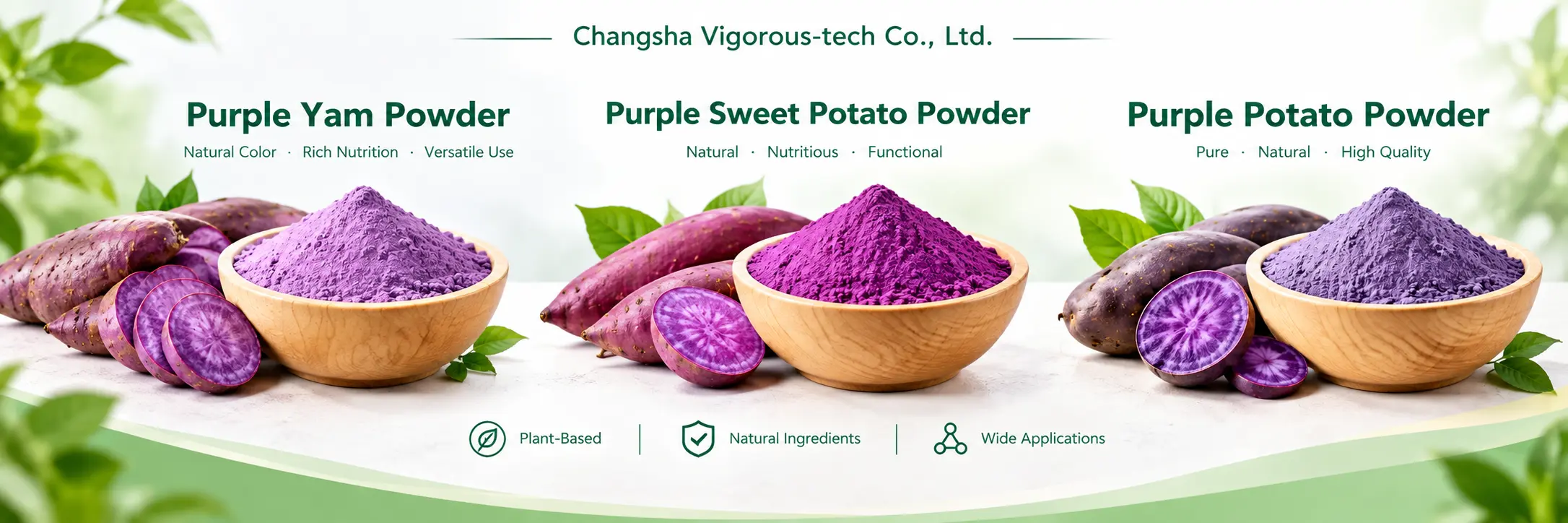
These three ingredients can look similar because all may display purple coloration. Nevertheless, they come from different botanical sources and serve different formulation purposes.
Understanding their differences is essential for ingredient buyers, product developers, and distributors.
4.1 Botanical differences
Purple potato extract typically comes from purple-fleshed potato varieties, Solanum tuberosum, in the nightshade family, Solanaceae.
Purple sweet potato powder comes from purple-fleshed sweet potatoes, Ipomoea batatas, in the morning glory family, Convolvulaceae. Purple sweet potatoes are widely studied as sources of anthocyanins and are used in a variety of food applications. Scientific review of purple sweet potato anthocyanins
Purple yam powder commonly refers to powder made from purple yam, Dioscorea alata, in the yam family, Dioscoreaceae. Purple yam is also known as ube in many food markets and is valued for its characteristic purple appearance and applications in traditional and modern foods.
Although their colors may overlap, these ingredients should not be treated as botanically equivalent.
4.2 Side-by-side comparison
| Comparison factor | Purple Potato Extract | Purple Sweet Potato Powder | Purpur-Yam-Pulver |
|---|---|---|---|
| Typical botanical source | Solanum tuberosum | Ipomoea batatas | Dioscorea alata |
| Ingredient format | Extracted fraction | Dried, milled whole ingredient | Dried, milled whole ingredient |
| Main formulation focus | Concentrated constituents, potentially anthocyanins | Whole-food solids, color, flavor, and texture | Whole-food solids, characteristic ube flavor, and texture |
| Starch content | Depends on extraction and purification | Generally contains starch | Generally contains starch |
| Anthocyanin content | Depends on cultivar and extract specification | Depends on variety and processing | Depends on variety and processing |
| Flavor contribution | Depends on extract composition | Characteristic sweet-potato notes may remain | Characteristic ube-like flavor may remain |
| Typical development direction | Pigment or specialized extract applications | Food powders, bakery, beverages, and desserts | Ube desserts, bakery, beverages, and specialty foods |
| Main purchasing priority | Marker content, solubility, color performance, and purity | Botanical authenticity, color, flavor, moisture, and microbiology | Botanical authenticity, color, flavor, moisture, and microbiology |
Note: These are general ingredient-selection guidelines, not universal specifications. Actual properties must be verified for each commercial product.
4.3 Purple Potato Extract vs. Purple Sweet Potato Powder
The main difference is the ingredient format and the intended function.
Purple potato extract is more appropriate to evaluate when the project requires selected extracted constituents, particularly when anthocyanin content or pigment performance is a primary specification.
Purple sweet potato powder is generally a better starting point when the product needs a whole-food ingredient that contributes bulk, starch, color, and characteristic sweet-potato properties.
Another important distinction is that purple sweet potato powder is not the same as purple sweet potato extract. A whole-food powder generally contains more of the original plant matrix, whereas an extract may concentrate selected constituents and remove some components.
For buyers comparing purple potato extract with purple sweet potato powder, the correct decision should be based on the intended function rather than the color alone.
If the target is a concentrated pigment, compare anthocyanin specifications and color performance. If the target is a purple-colored food ingredient, compare flavor, starch functionality, processing performance, and cost per finished-product batch.
4.4 Purple Potato Extract vs. Purpur-Yam-Pulver
Purple yam powder serves a different purpose in many food formulations.
Purple yam, or ube, is particularly valued for its distinctive flavor, purple color, and role in desserts, bakery products, ice cream, and beverage applications.
Purple potato extract, by contrast, may be selected for its extracted constituents rather than for the full sensory and textural characteristics of the original tuber.
For example:
These are starting points for ingredient selection, not absolute rules. The right choice depends on the actual specification and application.
4.5 Which ingredient is better for natural purple color?
There is no universal winner.
A properly specified purple potato extract may be attractive when a concentrated extract is required. Purple sweet potato powder can be appropriate when the whole-food ingredient is part of the product concept. Purple yam powder may be the better option when ube identity, flavor, and food texture are important.
For a fair technical comparison, request the same categories of information from each supplier:
This approach helps purchasing teams compare ingredients on measurable performance instead of relying on product names or photographs.
The manufacturing process depends on the target specification and the desired constituents.
A typical extraction workflow may involve several stages.
Step 1: Raw-material selection
Purple-fleshed potatoes are selected according to botanical identity, pigment characteristics, raw-material quality, and supplier requirements.
Cultivar, growing conditions, maturity, and storage history can influence the composition of the starting material.
Step 2: Cleaning and preparation
The raw material is cleaned and prepared for processing. Depending on the manufacturing method, it may be cut, crushed, or otherwise processed to facilitate extraction.
Step 3: Extraction
Selected compounds are transferred from the prepared plant material into an appropriate extraction medium.
Solvent composition, pH, temperature, extraction time, and the ratio of raw material to solvent can affect both extraction yield and the composition of the resulting extract.
The extraction process must be selected according to the intended product, applicable regulations, and required quality specifications.
Step 4: Filtration and concentration
The liquid extract is separated from insoluble plant material and may undergo concentration or further purification.
For anthocyanin-focused products, processing conditions must be carefully controlled because pigment composition and color can change during processing.
Step 5: Drying and finishing
Depending on the commercial format, the extract may be dried into a powder or supplied in another form. Carriers or processing aids may be used when appropriate to the formulation and product specification.
Step 6: Quality testing and packaging
Finished products should be evaluated against defined quality requirements. Relevant tests may include identity, anthocyanin content, moisture, microbiological quality, heavy metals, residual solvents where applicable, and other specification-dependent parameters.
Packaging should protect the ingredient from environmental factors that could compromise its quality during transportation and storage.
For B2B buyers, a transparent specification and suitable analytical documentation are essential for evaluating whether a product meets the needs of the intended application.
Finding a supplier is only the first step. The more important task is determining whether the ingredient is suitable for the target formulation and market.
Botanical identity and authenticity
Confirm that the product is genuinely derived from the intended purple potato species and that its identity is supported by appropriate documentation.
This is particularly important when comparing purple potato, purple sweet potato, and purple yam ingredients.
Anthocyanin content and standardization
If anthocyanins are the primary reason for purchasing the extract, ask whether the supplier offers a defined anthocyanin specification and an appropriate test method.
Do not assume that all purple potato extracts have the same pigment concentration or that a dark-purple appearance indicates a higher anthocyanin content.
Solubility and formulation compatibility
Clarify whether the ingredient is water-soluble, dispersible, or intended for another application. These characteristics can vary according to extraction, purification, and drying methods.
Request samples and evaluate them in the actual formulation.
Quality assurance and documentation
Depending on the application and target market, useful documentation may include:
The availability and scope of each document should be confirmed for the specific product rather than assumed from a supplier’s general certification list.
Supply reliability and customization
For manufacturers operating at scale, consistent quality, clear lead times, responsive technical communication, and dependable supply are as important as the initial price.
Buyers should discuss sample availability, minimum order quantity, bulk packaging, batch consistency, and the possibility of adjusting specifications to meet their application requirements.
Changsha Vigorous-tech Co., Ltd. supplies plant-derived ingredients to international B2B customers, with a focus on botanical extracts, functional powders, superfood ingredients, and natural sweeteners.
For overseas manufacturers, importers, distributors, and ingredient formulators, our approach emphasizes product selection, documentation, and practical sourcing support.
20+ Years of Industry Experience
Our experience in the botanical ingredient industry supports communication with buyers evaluating raw materials for different applications and markets.
One-Stop Botanical Ingredient Sourcing
In addition to purple-colored ingredients, our product portfolio includes botanical extracts, superfood powders, mushroom extracts, and natural sweeteners, helping customers consolidate sourcing where suitable.
Flexible MOQ and Sampling Support
We understand that product development often begins with small-scale formulation tests. Sample availability and minimum order quantities can be discussed according to the specific product and project requirements.
Quality Documentation
Relevant product specifications, COAs, and available third-party testing reports can be discussed during the sourcing process. Certification availability depends on the product, facility, and applicable scope.
Responsive Communication and Application Support
We aim to help customers clarify botanical identity, product specifications, application requirements, and documentation needs before moving toward commercial orders.
When evaluating purple potato extract, purple sweet potato powder, or purple yam powder, we encourage buyers to begin with the intended application. This makes it easier to identify the right ingredient format and avoid purchasing a product that does not match the formulation requirements.
Contact our team to discuss your target specification, expected annual volume, application, and destination market.
Is purple potato extract the same as purple sweet potato extract?
No. Purple potato extract typically comes from Solanum tuberosum, while purple sweet potato extract comes from Ipomoea batatas. They are different botanical ingredients and may differ in anthocyanin composition, color characteristics, and processing behavior.
Is purple potato extract the same as purple yam powder?
No. Purple potato extract is an extracted ingredient, while purple yam powder is generally made by drying and milling purple yam, commonly Dioscorea alata. They differ in botanical source, processing, composition, and typical formulation purpose.
Does purple potato extract contain anthocyanins?
Purple-fleshed potatoes naturally contain anthocyanins, but the amount retained in a commercial extract depends on the raw material and manufacturing process. Request an analytical specification to verify the content of the product you intend to purchase.
Is purple potato extract water-soluble?
Not every purple potato extract has the same solubility. Water compatibility depends on the extraction process, purification, formulation, and any carriers used. Buyers should confirm the specific grade and test it in their target application.
Can purple potato extract be used as a natural food color?
A suitable grade may be considered for natural-color development, subject to its composition, performance, and applicable regulations. The permitted use and labeling requirements must be checked for the destination market and specific food category.
How should purple potato extract be stored?
Follow the supplier’s product-specific storage instructions. In general, controlling moisture, temperature, and light exposure is important for protecting sensitive plant pigments. The appropriate packaging and shelf life should be confirmed using the actual product specification.
How do I choose between purple potato extract, purple sweet potato powder, and purple yam powder?
Start by identifying the main purpose of the ingredient.
Then compare botanical identity, composition, color performance, solubility, quality documentation, and cost at the intended usage level.
Choosing a botanical ingredient should begin with a clear understanding of its intended function.
Whether you are developing a natural-color concept, a powdered beverage, a confectionery product, or a specialized plant-based formulation, the right ingredient depends on its verified composition and performance in your product.
Changsha Vigorous-tech Co., Ltd. welcomes inquiries from ingredient importers, food manufacturers, distributors, and formulation companies seeking botanical ingredients for commercial applications.
To help us identify a suitable product, please share:
Contact us to discuss your botanical ingredient sourcing needs.
Website: https://www.vigorous-tech.com/
E-Mail: info@vigorous-tech.com
WhatsApp & WeChat: +86 13142031766
Changsha Vigorous-tech Co., Ltd. works with B2B customers and commercial ingredient buyers. Product availability, specifications, samples, and documentation are subject to confirmation.
This article is for ingredient selection and product-development information. It does not establish medical benefits or guarantee that a specific extract is authorized for every food or supplement application. Confirm product-specific specifications and local regulatory requirements before commercialization.
Nr. A6 Lugu International Industrial Park, 229# West Tongzipo Road, High-Tech Development Zone, Changsha 410205, Hunan, VR China
13142031766



We work with business customers and manufacturers. Individual consumer orders are not accepted.

 DE
DE  EN
EN  ZH
ZH  DE_AT
DE_AT  DE_CH
DE_CH  ES
ES  FR
FR  FR_CA
FR_CA  AF
AF  JA
JA  EN_AU
EN_AU  EN_GB
EN_GB  EN_CA
EN_CA  ES_CL
ES_CL  RU
RU